Jensen Huang used his first staff meeting after being reinstated as Nvidia’s chief executive to address a question that has hung over the company for weeks: who comes after him. His answer was that Nvidia does not need a succession plan of the kind a normal organisation would write.
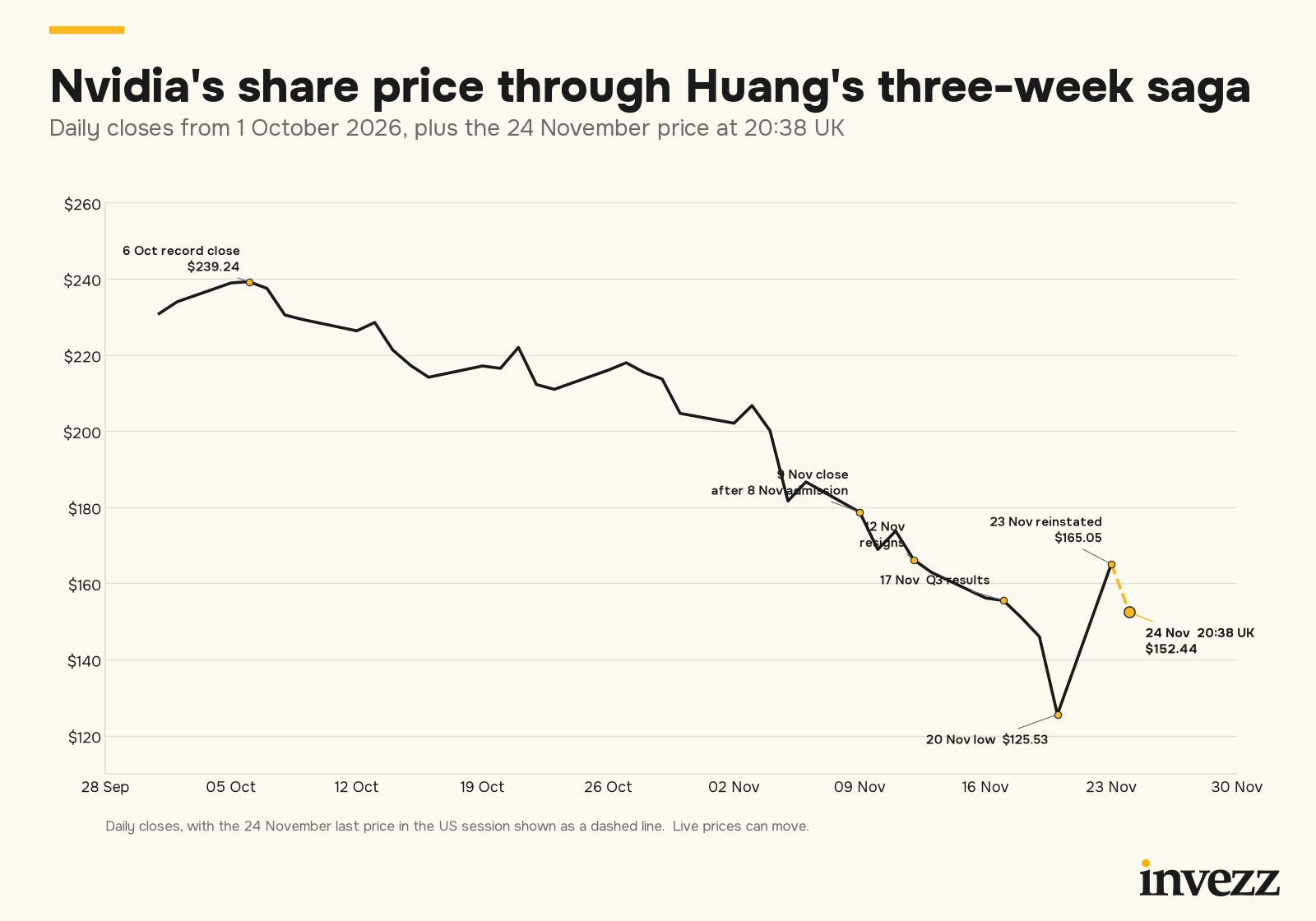
Nvidia shares were $152.44, down 7.6% on the day, at 20:38 UK time on 24 November.
What Huang told staff
The meeting on Tuesday was Huang’s first all-hands since the board brought him back on Monday, 23 November, 11 days after it announced his resignation.
“I also didn’t believe in succession planning. Let that sink in. I don’t believe in succession planning. I think it’s flawed,” Huang said.
“The idea of succession planning is not flawed. What people think succession planning means is flawed.”
He added: “There’s a reason why we don’t have succession planning, it’s not because we are unaware of the word. I’m the longest-running tech CEO in history.”
Huang argued that Nvidia can already run without him.
“All day long, this company can run autonomously, and you saw it. I promise you, whether I’m here or not, this company is wired up to execute, execute, and execute, and deliver on financial results and financial results.”
Huang said Nvidia does not require succession planning the way a normal organisation does, and that a formal plan would create unnecessary hierarchy.
“I made some terrible mistakes,” he said. “I was unfaithful to Lori, and I hurt my kids and, of course, I hurt all of you.”
A three-week reminder of key-person risk
On 8 November, Huang told staff he had been unfaithful to his wife.
On 12 November, the board announced that, “after disclosure of personal behaviour inconsistent with the company’s code of conduct, standards, and cultural norms, Jensen Huang voluntarily resigned his positions as President, CEO, and board member.”
Harvey C. Jones, the new board chair, repeated that wording on the 17 November earnings call, as reported by The Verge, and said the board “unanimously accepted his resignation and does not intend to reinstate Jensen as CEO.”
Colette Kress, the long-serving chief financial officer, became interim chief executive, and the board retained Heidrick & Struggles to search for a permanent successor.
Six days later, the same board voted unanimously to bring him back.
“The Board believes Jensen is the right person to lead NVIDIA, and that his reinstatement is in the best interests of our stockholders, employees, partners and customers,” Jones said in the 23 November statement. Our day-by-day timeline sets out that stretch in detail.
On 17 November, with Kress as interim chief executive, Nvidia reported third-quarter revenue of $115.8 billion, up 103% from a year earlier, and guided fourth-quarter revenue to $130.0 billion, plus or minus 3%. “From a business perspective, it’s business as usual,” Kress said on the call.
It was one of the peaks in a turbulent year for Huang and the company.
Shares closed at $125.53 on 20 November and jumped 31.5% to $165.05 on 23 November, opening more than 30% higher.
What Nvidia’s own filings say
The comments sit awkwardly beside Nvidia’s own filings. In its annual report for the year ended 25 January 2026, filed on 25 February, the company warned: “Additionally, we are highly dependent on the services of our longstanding executive team. Failure to ensure effective succession planning, transfer of knowledge, and smooth transitions involving executives and key employees could hinder our strategic planning, execution, and long-term success.”
The board’s corporate governance policies, dated 2 March 2023, go further. They require that each year “the Board shall review senior management development and discuss candidates to fulfil senior management’s, including the CEO’s, responsibilities on an interim basis in the event that a member of senior management is disabled or otherwise incapacitated.” That is an emergency plan, not a named heir, but it is still succession planning.
Analysts had already spelled out the risk. “Jensen is Nvidia. Nvidia is Jensen,” Bernstein’s Stacy Rasgon told CNBC’s “Squawk on the Street” on 9 November, adding that Huang “runs the thing pretty much top down” and “sort of pulls all the strings.” Melius Research wrote the same day: “The issue at Nvidia is that there is no clear successor to Jensen, and we had expected him to stay in this role for at least 10 more years.”
The structure around him is unusually flat. Huang told CNBC’s Becky Quick in September 2025 that he had as many as 60 direct reports; records reviewed by CNBC in early November showed 33.
The ‘too big to fire’ problem
Huang’s return has not closed the governance debate. “What does it mean if you have a company too big to fail or a CEO too big to fire?” Angela Mancini of Dow Jones told CNBC’s “Squawk Box Asia” earlier on Tuesday. “What does it mean when someone has 60 direct reports, and you literally are in a situation where you feel like you can’t fire them?”
Yang Wang of Counterpoint Research called the rebound a “founder premium”. CNBC put Nvidia’s value at about $3 trillion on Friday and almost $4 trillion after his return. “The reaction has been staggering,” Wang told CNBC’s “Squawk Box Europe”. “But is this level of dependence healthy?”
Jeff Herbst, a former Nvidia executive now at GFT Ventures, told CNBC he had written to the board calling for Huang’s return, but said oversight had to catch up with the company’s size. “I think the corporate governance, the succession planning, the legal function, the regulatory function, the political function, all has to scale at the same time,” he said.
Rasgon, speaking after the reinstatement and before the all-hands was reported, said the risk had been ignored. “We all knew that there was key man risk here. We all chose, and I’m including myself in that. We all kind of chose to just ignore it.” Succession, he said, is something “both Jensen and the board will have to figure out, and I think communicate to investors.” Charles Elson of the University of Delaware later told CBS News it would be “the first item on the board’s agenda,” a comment on the reinstatement rather than the all-hands remarks.
How other founder-led firms have handled it
Other founder-led firms have eventually named a successor in public. When Steve Jobs resigned as Apple’s chief executive on 24 August 2011, the board named Tim Cook, then chief operating officer, as CEO the same day. Apple said Jobs had “strongly recommended that the Board implement its succession plan and name Tim Cook as CEO.”
Microsoft took longer. Steve Ballmer announced on 23 August 2013 that he would retire once a successor was named. On 4 February 2014, after a five-month search, the board appointed Satya Nadella. John Thompson, then lead independent director, said: “The Board took the thoughtful approach that our shareholders, customers, partners and employees expected and deserved.”
Berkshire Hathaway gave the market more notice. On 5 May 2025 it said Warren Buffett had recommended, and the board had on 4 May unanimously approved, Greg Abel as president and chief executive from 1 January 2026, with Buffett remaining chairman. Abel took over on that date.
Nvidia has now lived through an emergency transition, reversed it, and heard its founder say a formal plan is not required. His nuance matters: he argued that “what people think succession planning means is flawed.” The 10-K, the board’s policies and the search firm retained on 17 November all suggest the company has, on paper, accepted that some planning is necessary.
What investors are watching
Nvidia was $152.44 at 20:38 UK on 24 November, down 7.6% from Monday’s close of $165.05, according to Yahoo Finance. That is still 21.4% above Friday’s close of $125.53, but 36.3% below the 6 October closing high of $239.24, Invezz calculations. The shares were already giving back part of Monday’s gain in Tuesday trade.
The pullback should not be read as a verdict on the succession comments alone. Using the same 24.186 billion diluted weighted-average shares, the live price implies a value of about $3.69 trillion, an Invezz calculation.
The board has said it will continue an investigation into reports that Huang was “the target of a foreign intelligence effort,” and that it is searching for a chief compliance officer. Those steps do not name a deputy, or a successor.
Rasgon’s point still stands. If Huang is right that Nvidia can execute whether he is there or not, the next test is whether the board will say so in a plan that investors can see. If he is wrong, the past three weeks were a preview, not an exception.
AI disclosure: AI tools assisted with research and drafting of this piece. An Invezz editor reviewed the facts, sources and wording before publication. Any opinions or analysis are Invezz’s, not those of an automated system.
The post Huang tells staff that Nvidia does not need a succession plan appeared first on Invezz