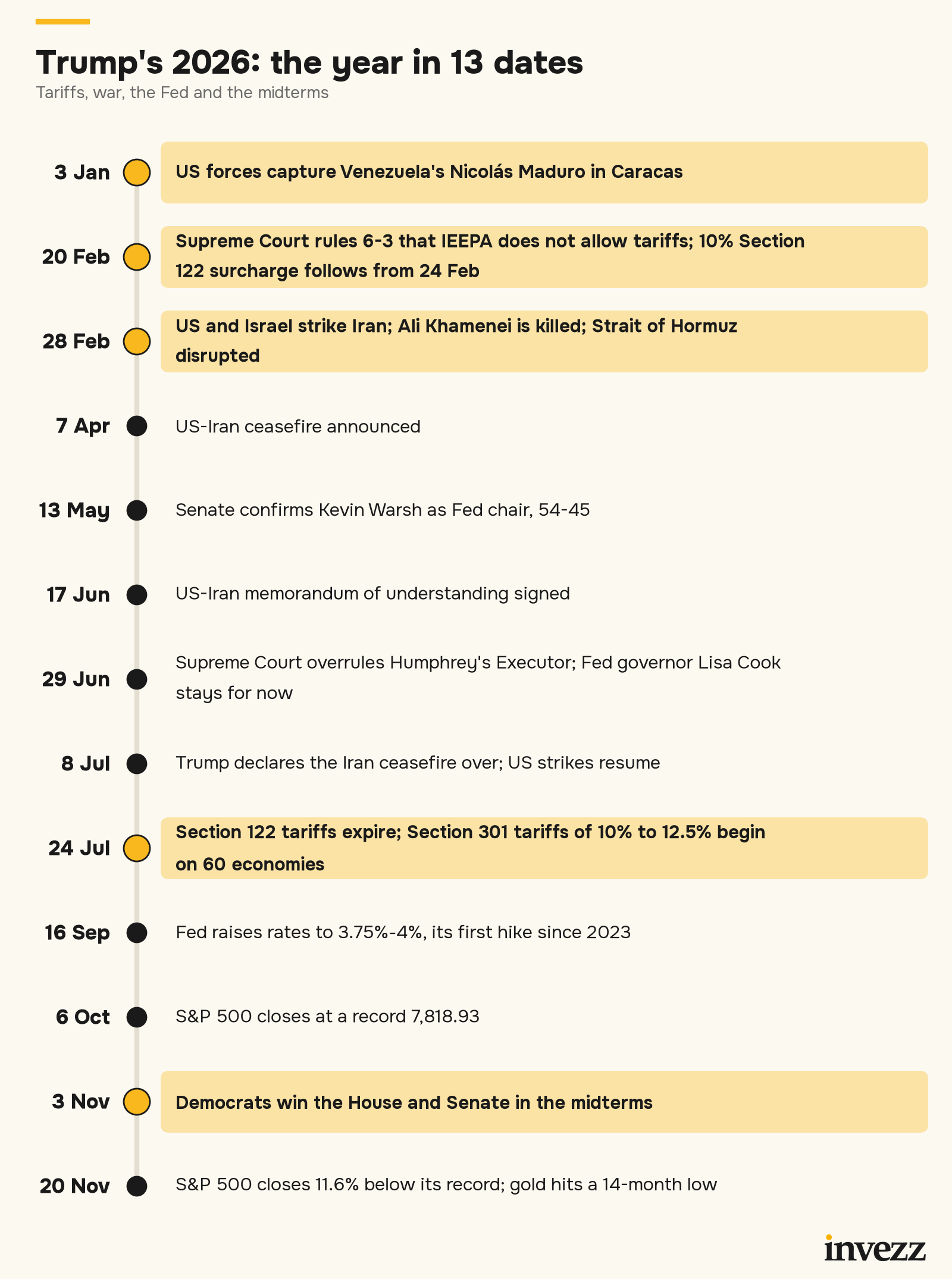
Donald Trump is ending 2026 with less power than he started it. The Supreme Court struck down his signature tariffs, a war with Iran pushed up fuel prices, and on 3 November 2026 voters handed Democrats both chambers of Congress.
Here is how the year unfolded, from the capture of Venezuela’s leader in January to a midterm rout, and what it did to markets.
Venezuela opens the year
The year began with force.
On 3 January 2026, US forces captured Venezuelan leader Nicolás Maduro and his wife, Cilia Flores, in a raid on Caracas, the Pentagon said. Both were taken to New York to face federal charges, including narco-terrorism.
Trump said the US would “run” Venezuela for a time and tap its oil, AP reported. AP called it America’s most assertive attempt at regime change since the 2003 invasion of Iraq, and said it raised questions over legality.
The Supreme Court strikes down the tariffs
On 20 February 2026, the Supreme Court ruled 6–3 that the International Emergency Economic Powers Act (IEEPA) does not let a president impose tariffs. Chief Justice John Roberts wrote that the law “contains no reference to tariffs or duties”.
Justice Brett Kavanaugh, joined by Clarence Thomas and Samuel Alito, dissented. He noted that other statutes could justify most of the same tariffs.
Trump moved within hours. A proclamation imposed a temporary 10% import surcharge under Section 122 of the Trade Act of 1974, from 24 February. He said the next day it would rise to 15%, but it took effect at 10% and stayed there until it expired.
Section 122 caps such duties at 150 days. They lapsed on 24 July 2026 with no extension from Congress. At that moment, Section 301 “forced labour” tariffs began on 60 economies: 10% for 17, including Canada, Mexico, India and the UK, and 12.5% for most others.
Reuters reported in August that the US had refunded about $100 billion of the struck-down duties, citing a court filing.
War in Iran and the oil shock
On 28 February 2026, the US and Israel struck Iran, killing Supreme Leader Ali Khamenei. Tehran restricted shipping through the Strait of Hormuz, which normally carries about a fifth of the world’s oil, Al Jazeera reports.
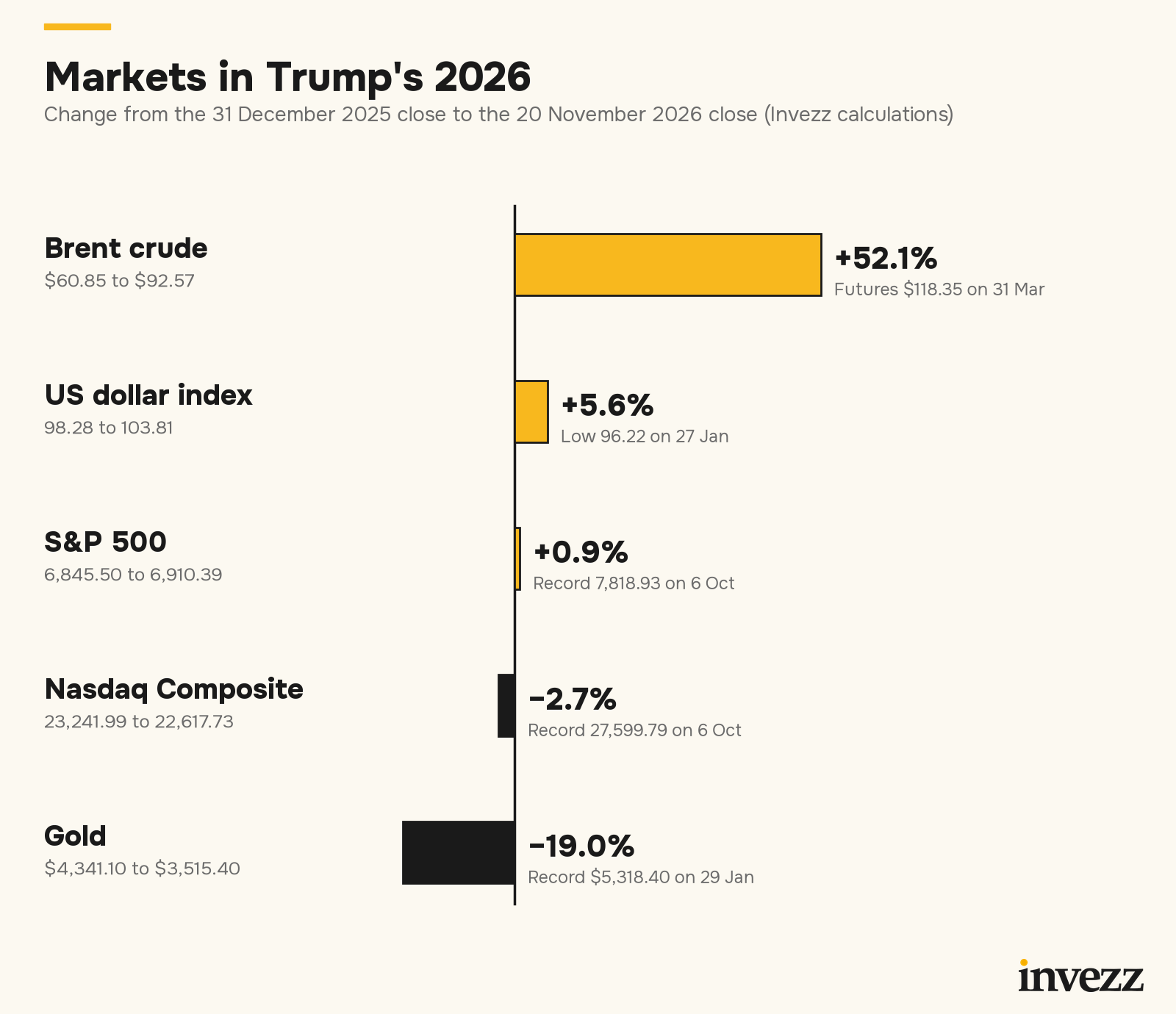
Brent futures rose from about $61 a barrel at the start of the year to $118 by the end of March. The US Energy Information Administration said that was the biggest quarterly rise, adjusted for inflation, in its data back to 1988.
A ceasefire on 7 April 2026 paused the fighting, and a memorandum of understanding on 17 June reopened the strait. After Iranian attacks on ships, Trump declared the ceasefire “over” on 8 July 2026, and US strikes resumed, ABC News reported.
Brent futures settled at $117.64 on 30 October 2026, the highest since the end of April, CNBC reported.
The US still blockades Iranian ports, and Qatari mediators are talking to Tehran. Trump is inclined to resume attacks after the New Year if talks fail, Reuters reported.
Warsh, the Fed and a fight over power
The Senate confirmed Kevin Warsh as Federal Reserve chair 54–45 on 13 May 2026, and he took the oath on 22 May. Trump wanted lower rates.
Instead, on 16 September 2026, the Fed’s rate-setting committee voted 12–0 to raise them by a quarter point, to 3.75%–4%, its first rise since 2023.
Trump demanded rates of “1%, or less” within hours. The committee held on 28 October 2026 by 10–2, with Lisa Cook and Beth Hammack voting for another rise. US consumer prices rose 0.4% in October after 0.6% in September, the Bureau of Labor Statistics said.
On 29 June 2026, the Supreme Court overruled Humphrey’s Executor in Trump v. Slaughter, letting him remove a Federal Trade Commission member. The same day it refused to let him remove Cook from the Fed board for now.
The midterm rout
Democrats won the Senate on 3 November 2026, flipping seats in Texas, Kansas, South Carolina, Iowa and Ohio, AP reported. Ballotpedia counts the new Senate at 56–44 to Democrats, including two independents who caucus with them.
In the House, Democrats lead 258–173 with four races uncalled, according to Ballotpedia, citing Decision Desk HQ projections. Republicans held a narrow majority before the vote.
AP said voters were angry over high prices, the Iran war and concerns about government corruption. Trump said “a part of it was Iran”, and told The New York Times he was “absolutely willing to accept those results”.
He also embraced a nickname.
He said on election day that his “ultimate power” is the veto and welcomed the label “Mr Veto”. He told Fox News Democrats would “send over things that are insane, and I’ll veto them”.
His approval is weak. An Economist/YouGov poll on 9–11 November put it at 32%, a low for his second term in that series. USA Today reported the poll.
How markets took it
Stocks were driven more by the war, rates and AI than by politics (Invezz analysis). The S&P 500 rose 0.7% on the day of the tariff ruling and barely moved on the first trading day after the Iran strikes.
It fell to a 2026 closing low of 6,343.72 on 30 March, 7.3% below its end-2025 level (Invezz calculation).
It then rallied 23% (Invezz calculation) to a record close of 7,818.93 on 6 October 2026, before a sell-off led by AI stocks. On Friday 20 November 2026, it closed at 6,910.39, up 0.9% for the year but 11.6% below the record (Invezz calculations).
The S&P 500 rose 1.6% the day after the midterms, Yahoo Finance data show, while gold futures gained 3.4%.
Gold was the year’s wild card. Futures hit a record settlement of $5,318.40 on 29 January 2026 and closed at $3,515.40 on 20 November, 33.9% lower (Invezz calculation). Investing News called it a 14-month low as rate-hike fears lifted the dollar.
On Monday morning, before the US open, gold futures were near $3,618, Brent near $88.50 and the dollar index near 104.05 (Yahoo Finance, 13:17 GMT). The figures above are Friday’s closes.
What to expect in 2027?
Trump keeps broad executive tools. Trade is now run through Section 301 and Section 232 cases, which need an investigation first, the Congressional Research Service notes. More Section 301 probes are under way.
Divided government arrives in January, with investigations, Senate scrutiny of nominees and vetoes. Trump expects deals after a month or two of vetoes, The Independent reported.
Three tests come first: the Fed’s 8–9 December meeting, where markets expect another quarter-point rise; the Iran talks; and whether Trump and Xi Jinping, who met in Shenzhen on 19 November 2026 without announcing a tariff deal, turn an agreed action plan into trade terms.
Invezz analysis: whether 2027 brings deals with Democrats or a long deadlock may decide if the 2026 rout was a blip or the start of a lame-duck presidency.
AI disclosure: AI tools assisted with research and drafting of this piece. An Invezz editor reviewed the facts, sources and wording before publication. Any opinions or analysis are Invezz’s, not those of an automated system.
The post How 2026 went for Trump, from tariffs and Iran to the midterm rout appeared first on Invezz