
Lenovo Group stock remained under pressure on Thursday after the technology company published its financial results. It was trading at H$16.72, down by over 55% from its all-time high. Its technicals suggest that it has more downside in the near term.
Lenovo Group’s business continued doing well
Lenovo Group, a leading competitor to Dell and HP Enterprise, reported strong financial results for the latest quarter. The figures show the company’s business continued to grow, driven by ongoing investment in artificial intelligence (AI).
The results showed that its revenue growth gained momentum. Its revenue soared by 46% YoY to $30.2 billion, with its AI related figure rising by 79.
A look at its segments shows the business is thriving. The Intelligent Devices Group generated more than $17.4 billion in revenue, up 17% year on year, with an operating margin of 7.1%. This growth came as the company prioritized higher-priced devices, even as the number of units sold fell.
Indeed, its premium PCs contributed to 63% of all PC shippings during the quarter. Recent data by Gartner showed that its PC sales dropped by 22.4% to 14.9 million during the quarter. Its PC margins have also dropped because of the ongoing memory shortage.
The Infrastructure Solutions Group’s revenue surged 178%, and its AI server pipeline reached $54 billion.
Lenovo’s AI business is being driven by American hyperscalers, neoclouds, and Asian data center companies. Some of the revenue is coming from Asian data centers, especially in places like China and Malaysia. Lenovo’s Solutions and Services Group (SSG) grew by 205 to $3.1 billion.
Still, the company made a $713 million loss during the quarter after losing over $1.19 billion in the same period last year. The loss was driven by fair value loss of $3.9 billion on derivative financial liabilities.
Concerns about AI growth remains
Lenovo Group and other competitors have dropped in the past few months. For example, Dell stock has plunged by 46% from its highest point this year. It has dropped to its lowest level since May 28 this year.
HP Enterprise has also dropped to $45.78, down by 37% from the year-to-date high, while Super Micro Computer (SMCI) dropped by 52% in this period. Other companies in the AI space like Micron, SanDisk, and Western Digital have all plunged.
Investors are concerned about the potential slowdown in the coming months that would impact demand for its products.
On the positive side, there are signs that demand is continuing growing. For example, Nvidia’s earnings report showed that its revenue jumped to $115 billion in the third quarter, much higher than the expected $108 billion.
Lenovo Group stock technical analysis
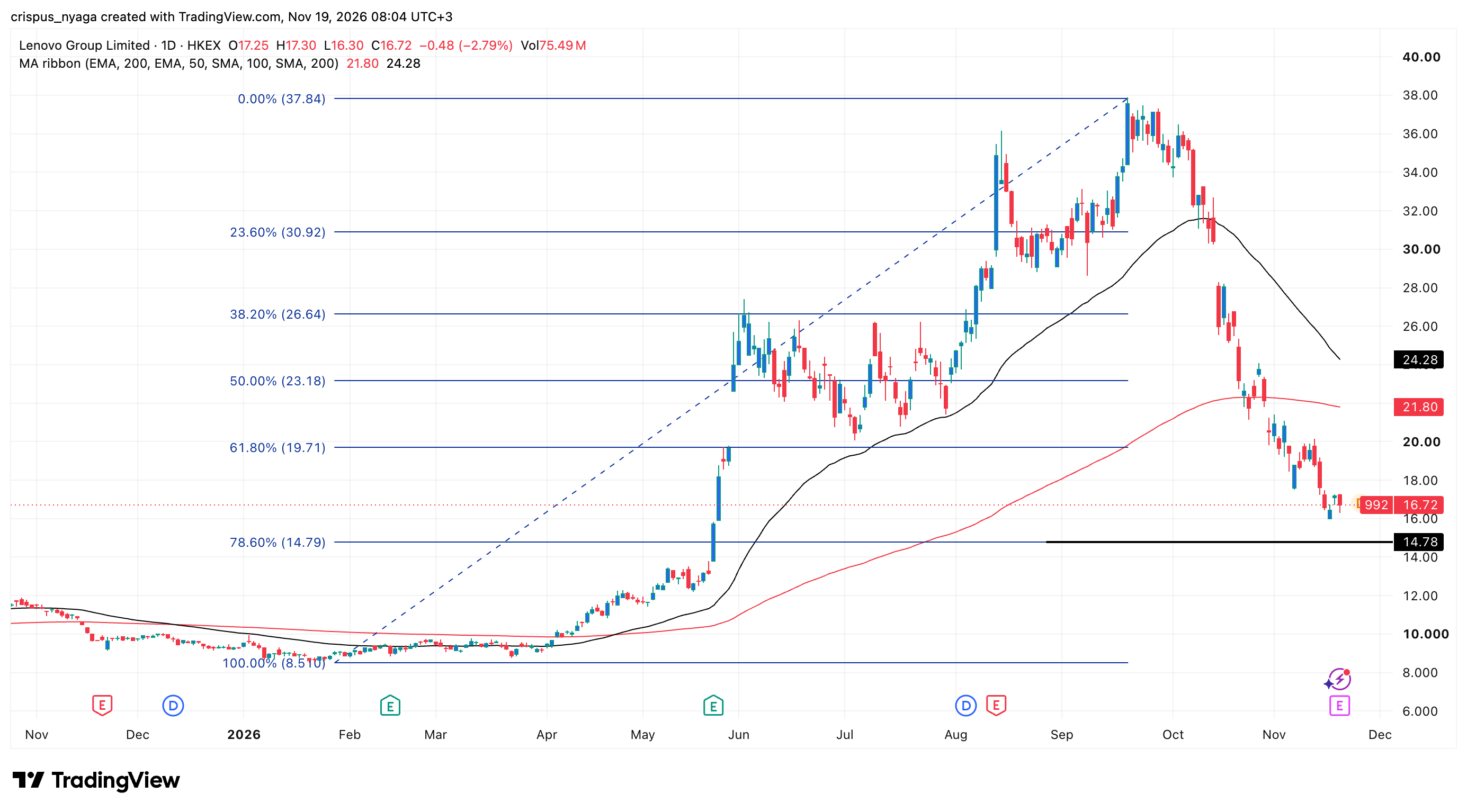
Lenovo Group stock chart | Source: TradingView
The daily chart shows that Lenovo Group’s stock has continued its strong sell-off in the past few months. It has slumped from $37 in September to the current $16.7. This retreat coincided with the ongoing weakness of other top companies in the AI space.
The stock has dropped below the 61.8% Fibonacci Retracement level of $19.73. In most cases, moving below that retracement normally confirms a bearish breakout.
The stock has dropped below the 50-day and 200-day Exponential Moving Averages (EMA) and the two lines are about to cross each other. A crossover would lead to a death cross, a popular bearish outlook.
Therefore, the stock will likely continue falling, potentially to the key support level of $14.78, the 78.6% retracement level. A move below that level will point to more losses towards $10. In the future, however, there is a likelihood that the stock will bounce back, potentially to $20 and above.
The post Lenovo Group stock analysis after earnings: is this Dell rival a buy or sell? appeared first on Invezz