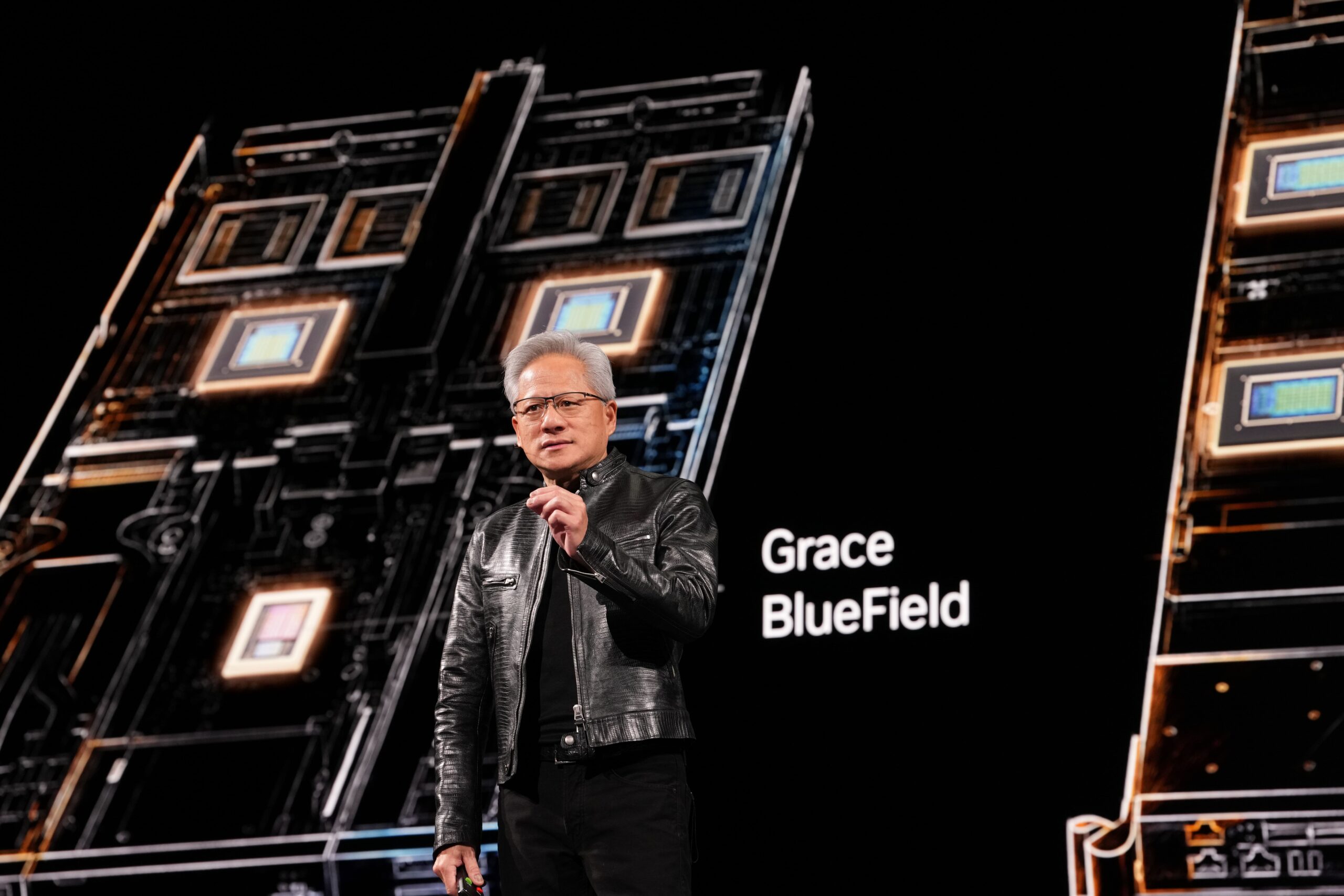
The allegations surrounding Nvidia chief executive Jensen Huang have raised questions about more than the company’s leadership.
They have also brought national security concerns, US-China technology policy and the concentration of investor confidence around a single executive back into focus.
Huang has admitted to being unfaithful, while reports have raised allegations involving a Chinese businesswoman who US intelligence reportedly believes was an operative for the Chinese state.
Nvidia’s board has been investigating the matter. The company has said its investigation found no reason to believe sensitive information was compromised.
But the episode has added to pressure on Nvidia shares, which have also been affected by a broader technology sell-off.
Susannah Streeter, chief investment strategist at Wealth Club and a former BBC business anchor, said the controversy had created another source of uncertainty for investors already assessing the technology sector’s valuations and exposure to geopolitical risk.
Speaking on the latest episode of Zero Sum, Streeter said Nvidia’s importance to the artificial intelligence industry meant questions about Huang’s judgment could have an outsized effect on the company.
“So I think if there are questions about his judgment, it can have this outsized effect,” she said.
Nvidia’s reliance on Jensen Huang creates a leadership risk
Huang has become closely associated with the AI boom, helping explain the scale of the opportunity to investors while positioning Nvidia as a central supplier of the computing infrastructure behind it.
Streeter said that relationship had helped create a premium around the company.
Nvidia’s chips have moved from their traditional role in graphics and gaming into the infrastructure supporting a much broader AI buildout.
That prominence also creates vulnerability. A substantial amount of investor confidence is tied to Huang personally, making the company’s reputation and leadership structure particularly important during a period of heightened scrutiny.
Streeter suggested Nvidia could try to demonstrate that its leadership bench extends beyond its chief executive.
Investors would want reassurance that the company could manage a transition of power without losing strategic direction.
She pointed to Apple’s transition from Steve Jobs to Tim Cook as an example of a founder-led company moving into a new phase under a different leadership style.
“You need the kind of founder to really propel the vision, but then you might need a different type of personality to take over to lead the company to the next stage,” Streeter said.
She also raised concerns about the concentration of authority around other prominent technology executives.
At Tesla and SpaceX, she said, Elon Musk’s leadership appeared closely tied to his personal vision.
The experience of Tesla showed how investors could react when they believed a chief executive was dividing attention between multiple responsibilities.
Streeter said concerns about Musk’s focus had previously weighed on Tesla shares.
Nvidia scandal adds a national security dimension to chip exports
The allegations have also complicated an already contentious debate in Washington over whether advanced AI chips should be exported to China.
President Donald Trump has taken a more pragmatic approach to the issue, Streeter said, arguing that the United States should be able to monetise its technological advantage rather than surrender potential markets to Chinese competitors.
That position has come under greater scrutiny following the Nvidia controversy.
“I think the Nvidia scandal has added another national security dimension to what was a really politically charged debate,” Streeter said.
She expects lawmakers to seek greater oversight of advanced chip exports, including measures requiring companies to track chips overseas to prevent smuggling.
She also said Washington could put pressure on allies to restrict exports of semiconductor manufacturing equipment to China.
The political environment could make that debate more difficult for technology companies.
With Democrats gaining control of the House and Senate, Streeter expects increased pressure for tighter AI regulation and restrictions on the influence of large technology companies.
The shift could also affect expectations for data centre investment.
Streeter said investors had already expressed concerns about a potential slowdown in infrastructure spending, given the extent to which the AI buildout has supported technology valuations and US economic output.
Investors should look beyond Nvidia’s recent share-price moves
For investors, Streeter said the controversy was a reason to reassess portfolio concentration rather than make an immediate decision to sell Nvidia shares.
She warned that investors could have more exposure to a small group of US technology companies than they realise, particularly through broad global funds.
“You have to make sure that you are well diversified across sectors and geographies and make sure that you haven’t put all your eggs in one basket,” she said.
Streeter argued that investors should distinguish between short-term volatility and the longer-term prospects for the AI industry.
Nvidia remains an important supplier, and demand for its chips is still high.
But that does not mean every company associated with the AI boom will become a long-term winner.
She compared the current investment cycle with the dot-com period, when many high-profile companies failed even as some businesses, including Amazon, went on to become major beneficiaries of the internet’s expansion.
Investment decisions should also reflect when an investor expects to need the money.
Streeter said people approaching retirement or expecting to withdraw funds within five years should be more cautious about exposure to volatile stocks.
For younger investors with longer time horizons, she said taking some market risk could make sense, while dividend-paying stocks and reinvestment strategies could help compound returns over time.
The next test for Nvidia and its peers will not be limited to revenue growth.
Streeter said investors also need to assess whether companies’ capital expenditure is producing returns that justify the valuations attached to the AI buildout.
Regulation and infrastructure spending will shape the next phase of AI
Streeter argued that tighter oversight of AI could ultimately benefit the industry if it improves public confidence and creates clearer safeguards.
“Longer term, I think it’s very important that there are checks and balances and guardrails and much greater transparency and also that the American people are in support of this technological development,” she said.
She warned that a growing backlash against AI could undermine its wider deployment, particularly if the public believes the benefits are accruing mainly to large technology companies while workers face job insecurity and households bear higher energy costs.
Streeter said more communication was needed about how the technology would be used and how its benefits could reach the wider economy.
She pointed to potential applications in drug discovery, medical breakthroughs and energy as examples of areas where AI could deliver broader benefits.
Even if data centre construction slows, she remains positive about companies supplying the underlying infrastructure.
Power generation, electricity networks and utilities will still be needed to support AI adoption and wider energy requirements.
She is more cautious about companies committing enormous sums to infrastructure without demonstrating sufficient returns.
The gap between investment and eventual economic benefits could create pressure on valuations, particularly if customers become more hesitant to continue spending.
Trump’s remaining two years could bring further policy uncertainty
Streeter said the Middle East conflict and its impact on energy prices would be among the first issues to watch as Trump enters the final two years of his presidency.
Oil prices had fallen from their October highs amid expectations that negotiations with Iran could become more productive.
She suggested that Democrats’ influence over the federal budget could give them leverage to push the administration towards a resolution.
Energy prices will also matter for inflation and the Federal Reserve’s policy outlook. Higher inflation could keep pressure on interest rates, affecting equity valuations and the calculation of future corporate earnings.
At the same time, Streeter expects state-level governments to play a greater role in determining where data centres are built and how quickly infrastructure projects proceed.
The result, she said, may not be a complete halt to the AI buildout but a more measured expansion, with technology companies facing greater scrutiny over the costs and benefits of their projects.
For investors, the Nvidia controversy is therefore part of a wider reassessment of the AI trade.
Leadership risk, geopolitical exposure, regulation and the returns on infrastructure spending are increasingly difficult to separate from the industry’s growth prospects.
Watch the full episode of Zero Sum for the complete discussion with Susannah Streeter on Nvidia, Jensen Huang, US-China chip policy, AI investment, and the outlook for markets.
The post Is Huang bigger than Nvidia? Susannah Streeter answers on ‘Zero Sum’ appeared first on Invezz