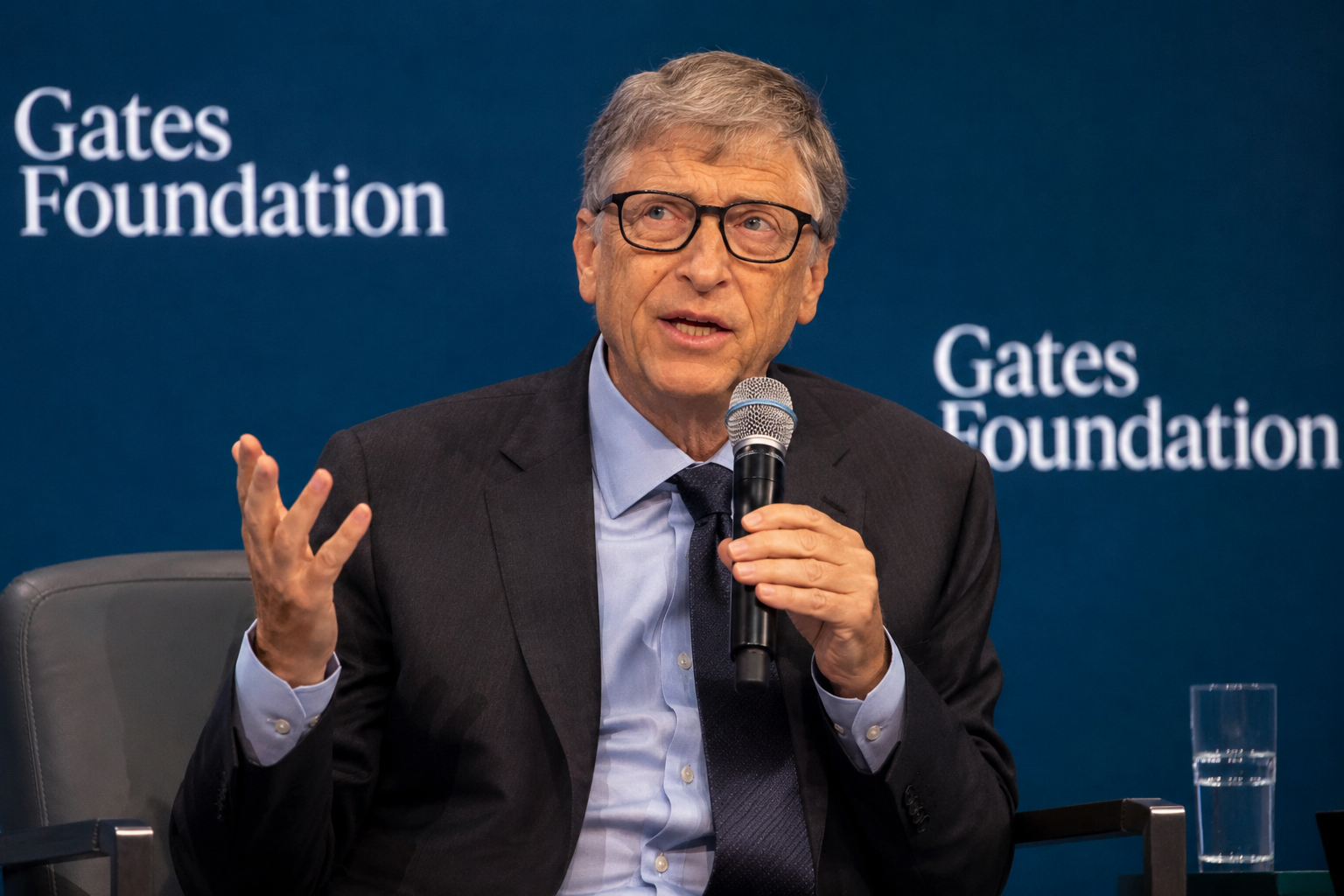
Bill Gates built one of the world’s most valuable software companies, and yet the trust that funds his foundation no longer owns a single Microsoft share.
That sounds dramatic, but the more revealing detail is what remains inside the Gates Foundation Trust: a public equity portfolio of roughly $33 billion, with about 46% now sitting in just two stocks: Berkshire Hathaway and Waste Management.
It is an odd-looking pair at first glance, as one is Warren Buffett’s conglomerate, while the other collects rubbish.
But, together they say a lot about how Gates’ philanthropic machine is being run.
Exit that was not a vote of no confidence
The Microsoft sale is the headline, but it should not be read as a break with the company Gates founded.
The Bill & Melinda Gates Foundation Trust sold its remaining 7.7 million Microsoft shares in the first quarter of 2026, completing a phased exit from a position that, a year earlier, had still been worth billions.
The latest 13F filing shows Microsoft at zero, after a full sell-down of the remaining stake.
That is striking because Microsoft has long been the emotional centre of the Gates story. But this was a trust-level portfolio decision, not a personal repudiation.
Gates himself still owns about 103 million Microsoft shares, worth roughly $43 billion, according to market data cited by The Motley Fool.
The better way to understand the move is as a liquidity and risk-management decision.
As one market commentary put it, the trust was behaving “like a portfolio manager, not a founder”.
That distinction matters as the foundation is no longer being run as a permanent institution that can simply sit on concentrated positions forever.
Gates said last year that the foundation expects to spend more than $200 billion between now and 2045, when it plans to wind down.
Buffett’s gift that keeps on giving
The largest remaining holding is Berkshire Hathaway, which accounts for roughly a quarter of the portfolio at current prices.
Warren Buffett has been donating Berkshire shares to the Gates Foundation for years, and the foundation says its endowment has been funded by Bill Gates, Melinda French Gates and Buffett.
Bill Gates is the trustee of the foundation trust, while Cascade Asset Management manages the endowment.
Buffett’s giving also comes with a practical consequence.
The foundation has been required to spend the value of its annual gift, plus an additional amount tied to its remaining assets.
In plain English, Berkshire keeps flowing in, while the foundation must keep money flowing out, and that creates a natural churn inside the portfolio.
Berkshire also fits the trust’s current job as it is diversified, cash-generative and built around businesses that are not dependent on one technology cycle.
Under new chief executive Greg Abel, Berkshire produced solid first-quarter results, and its shares have recently traded at about 1.4 times book value, near the lower end of their recent range.
Why a trash company is the quiet compounder
The second major holding is WM.
It is less glamorous than Microsoft, but accounts for about 18% of the trust’s public equity portfolio, and it has been held for decades with relatively little turnover.
The investment case is simple as WM owns or operates the largest landfill network in the US and Canada, with 262 landfill sites, according to its annual report.
That infrastructure is difficult to replicate as permits are hard to obtain, local opposition is common, and smaller haulers often need access to large disposal networks.
That gives WM scale, pricing power and a business model that tends to hold up even when the economy slows.
Motley Fool analyst Adam Levy described it as “a boring business with a seemingly insurmountable competitive moat.”
The post Why 46% of Bill Gates’ fund is now concentrated in just 2 stocks appeared first on Invezz