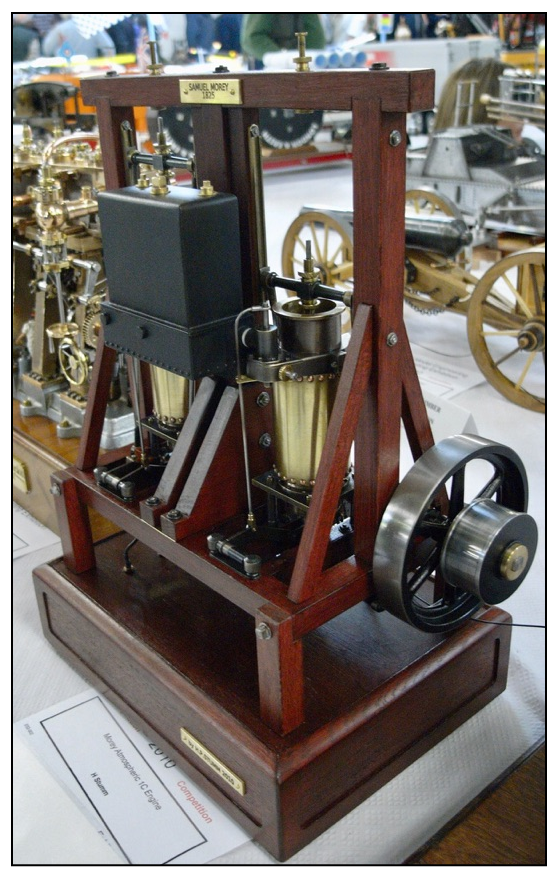
Just 50 years after America’s founding, the New Hampshire inventor, Samuel Morey, received the nation’s first patent for an internal combustion engine. The motor’s potency was soon realized when Morey attached the two-cylinder machine to a horse wagon, fired it up, and watched it careen into a ditch after falling off the contraption. Despite this inauspicious test run, the motor’s performance was enough for him to envision a future where the engine would transform the transportation and shipping industries.
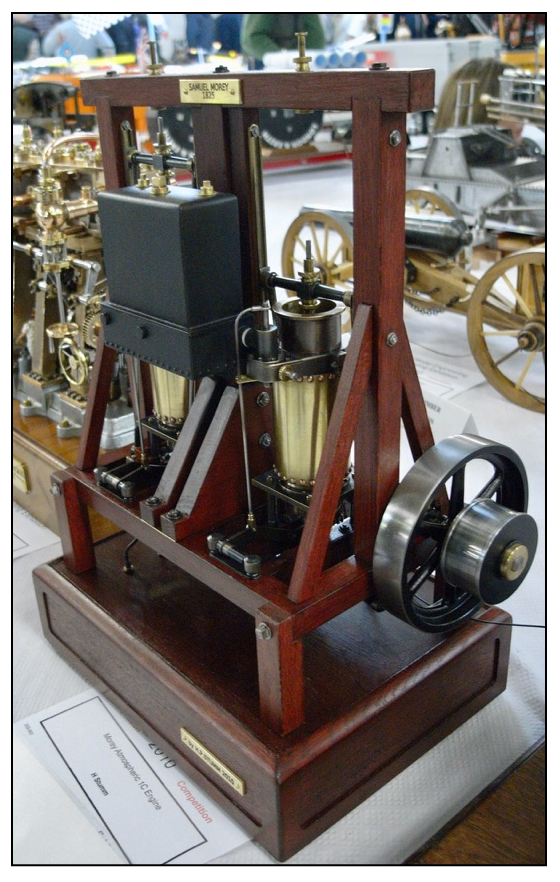
Another sixty years would pass before Morey’s internal combustion engine (ICE) would become commercially viable for ground transportation. Even then, its success depended on an international division of labor, culminating in Carl Benz’s famous Motorwagen. The advent of the ICE and the productivity it spurred have been at the root of improved standards of living, the likes of which haven’t been seen in all of human history.
In little more than a century, the ICE made personal mobility affordable for ordinary households, and its practical impact is undeniable. It opened up labor market opportunities, lowered the cost of distributing goods, and provided working-class people with access to distant employment, health care, and education to an extent never before realized. Even in a post-pandemic world, where many work from home, 3 out of 4 Americans still use personal vehicles for their daily commutes. The contribution that these engines has made to wealth creation and modern living is not contested.
Unlike the early days of the automobile, where owning a vehicle was a source of status, leisure, and thrills, it has become a cornerstone of middle- and lower-class productivity and wealth accumulation. For lower-income households, vehicle access isn’t just a lifestyle choice. It’s a prerequisite for participation in the labor market.
A study from the early 2000s indicated that the strong positive connection between automobile access and employment outcomes does not hold for public transportation, noting: “enhancing car access will notably improve employment outcomes among very-low-income adults, but other assistance [like public transport and housing assistance] will have, at best, marginal effects.”
However, the legacy of improved lives and productivity is being put to the test, and policymakers from around the world are proposing the elimination of this engine of human improvement, coming from the “green” movement. Indeed, there’s a deep, inescapable contradiction in the greens’ de-growth agenda. Its advocates claim they’re helping the poor. In fact, their policies accomplish the opposite. There’s hardly a clearer case of this problem than their support for policies that restrict affordable, high-output mobility.
Despite these realities, states like California motor ahead with edicts like the “Advanced Clean Cars 2” measure that call for 100 percent of new cars sold to be zero-emissions by 2035. While legal battles are still brewing over these decrees, over a dozen other states like New York, Washington, and Massachusetts have adopted the Golden State’s standards. Further intrigue involves the EPA’s nullification of the 2009 “endangerment rule,” arguing that CO₂ emissions do not endanger public health and welfare. This led California to seek and gain a special exemption to ignore the EPA’s decision in order to speed up its demolition of the ICE automobile market.
While the legal drama unfolds, the economic impact of California’s interventions is much more straightforward. The poor will be disproportionately harmed.
There’s no doubt that car ownership represents a sizeable share of lower-income households’ expenditures. Nonetheless, a survey of households with less than $40,000 of annual income found that nearly 90 percent of them said that acquiring a new or used car was worth the cost. This highlights the subjective but still enormous importance of independence, workplace reliability, and family convenience that lower-income households still desire. In short, they themselves report that despite the tradeoffs, they still prefer to pay for a vehicle’s costs than to go without. Cutting off the poor, who typically purchase older, cheaper models, and restricting them to more expensive models would shut more of them out of what they need to make their household lives work.
California’s schemes and those like them don’t just hurt the poor; they are designed to help the already wealthy. A prime example included a Biden-era tax rule that allowed up to a $7,500 tax credit for full EV purchases. Even though the “One Big Beautiful Bill” eliminated this provision, the “OBBB” still provides a $1,000 tax credit applied to the hardware and installation of an in-home EV charger, a high-priced accessory for the relatively wealthy. On average, those who install EV chargers are 45 years of age and have annual household income of around $200,000.
The harm to the poor in America when locked out of the use of ICEs and petroleum products also holds true across the globe. The explanation of why this is the case has come from energy expert Alex Epstein, the author of The Moral Case for Fossil Fuels, and Fossil Future. Epstein argues that energy consumption should be evaluated based on its positive contribution to human flourishing, rather than CO₂ emissions alone.
Despite the claims of the global doom-and-gloomers and left-leaning California legislators and bureaucrats, passenger vehicles are far from the primary source of their concerns. According to the World Resources Institute, road transportation accounts for just 12.2 percent of all global emissions. Further examination reveals that about 75 percent of that comes from passenger vehicles, for a small fraction of about nine percent of all CO₂ production. [Note: in the figure below, ground transport is contained within the “Energy” portion of the chart]
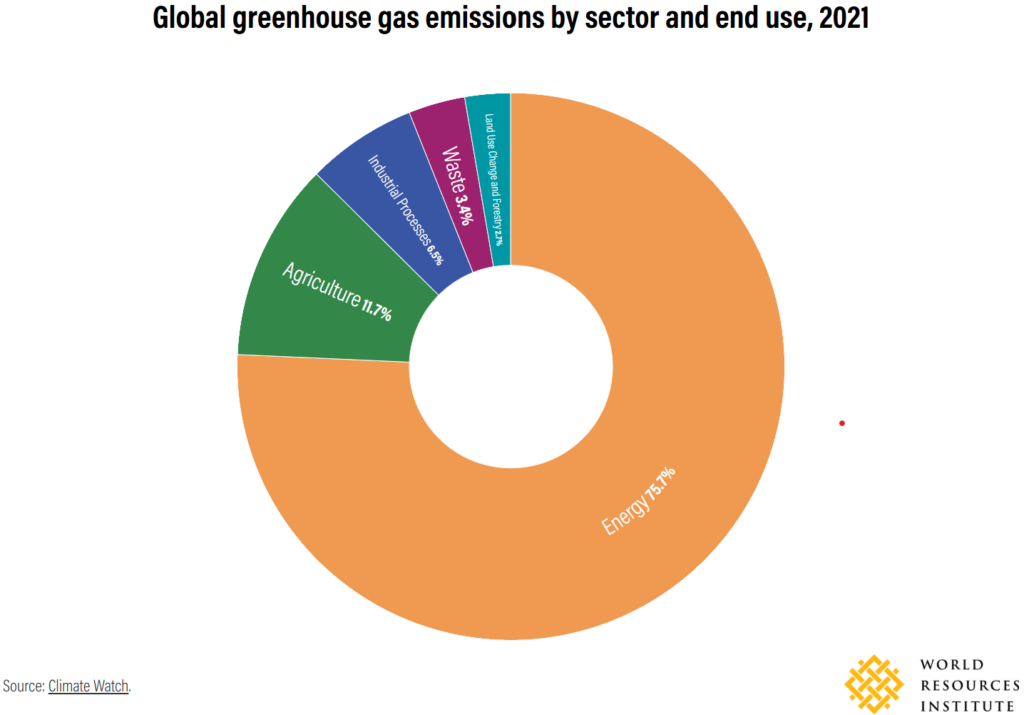
No matter the realities of global CO₂ output and its sources, the international de-growth movement refuses to acknowledge that the emissions that come from economic productivity are the driver of wealth and the uplift of the poor. If one is cynical, it might appear as though they prefer an impoverished world. If they did, then the elimination of these world-changing engines is one way to get there. Indeed, from a global perspective, the correlation between productivity, wealth, capital accumulation and use, and CO₂ emissions is undeniable. Conversely, if you want a country to remain poor, you can ditch the tractors, pick up the shovels, and lower your productivity, living standards, and life expectancy.
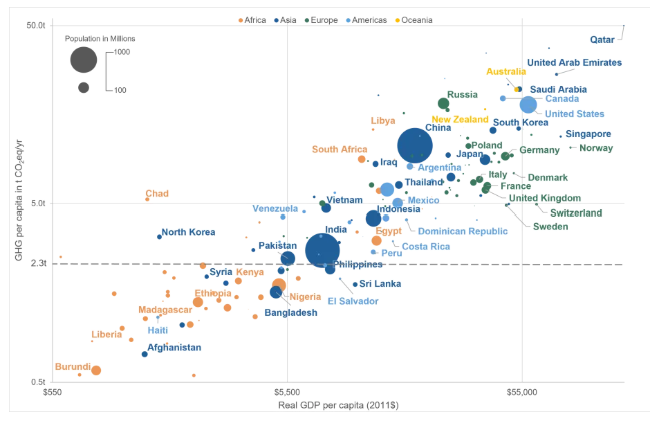
Although EVs largely remain the toys of the wealthy in the US and Eurozone, governments around the world still claim that their adoption is necessary to save vulnerable people from environmental apocalypse. Rather than saving these people from yet-to-be-seen disasters, ongoing access to Samuel Morey’s technology has been shown to bring about higher standards of living for the poor. Further attacks on internal combustion motors will stunt the progress that lower-income households across the globe have enjoyed because of their relatively low-cost availability and use. For the sake of the poor, the types of regulatory mandates that have favored EV makers and their wealthy consumers should be revoked, repealed, and thrown into reverse.