<?xml version="1.0" encoding="UTF-8"?><feed
	xmlns="http://www.w3.org/2005/Atom"
	xmlns:thr="http://purl.org/syndication/thread/1.0"
	xml:lang="en-US"
	>
	<title type="text">Girls Rock Investing</title>
	<subtitle type="text">Your daily news source covering investing ideas, market stocks, business, retirement tips from Wall St. to Silicon Valley.</subtitle>

	<updated>2026-11-15T10:10:06Z</updated>

	<link rel="alternate" type="text/html" href="https://girlrocksinvesting.com/" />
	<id>https://girlsrockinvesting.com/feed/atom/</id>
	<link rel="self" type="application/atom+xml" href="https://girlsrockinvesting.com/feed/atom/" />

	<generator uri="https://wordpress.org/" version="6.1.16">WordPress</generator>
<icon>https://girlsrockinvesting.com/wp-content/uploads/2025/01/Group-7-33.png</icon>
	<entry>
		<author>
			<name>Girls Rock Investing</name>
							<uri>https://girlrocksinvesting.com</uri>
						</author>

		<title type="html"><![CDATA[Is AI Mode killing the internet’s search-based business model?]]></title>
		<link rel="alternate" type="text/html" href="https://girlsrockinvesting.com/2026/11/15/is-ai-mode-killing-the-internets-search-based-business-model/" />

		<id>https://girlsrockinvesting.com/2026/11/15/is-ai-mode-killing-the-internets-search-based-business-model/</id>
		<updated>2026-11-15T10:10:06Z</updated>
		<published>2026-11-15T10:10:06Z</published>
		<category scheme="https://girlrocksinvesting.com/" term="Ideas" />
		<summary type="html"><![CDATA[<p><img width="150" height="150" src="https://girlsrockinvesting.com/wp-content/uploads/2026/11/Google-AI-mode-on-a-pc-VKxSoX-150x150.png" class="attachment-thumbnail size-thumbnail wp-post-image" alt="" decoding="async" srcset="https://girlsrockinvesting.com/wp-content/uploads/2026/11/Google-AI-mode-on-a-pc-VKxSoX-150x150.png 150w, https://girlsrockinvesting.com/wp-content/uploads/2026/11/Google-AI-mode-on-a-pc-VKxSoX-585x585.png 585w" sizes="(max-width: 150px) 100vw, 150px" />When AI chatbots burst onto the scene, there was chatter that they would kill Google search and the surrounding business models.  The latest fiscal results are shedding some light on&#8230;</p>
<p>The post <a rel="nofollow" href="https://girlsrockinvesting.com/2026/11/15/is-ai-mode-killing-the-internets-search-based-business-model/">Is AI Mode killing the internet’s search-based business model?</a> appeared first on <a rel="nofollow" href="https://girlsrockinvesting.com">Girls Rock Investing</a>.</p>
]]></summary>

					<content type="html" xml:base="https://girlsrockinvesting.com/2026/11/15/is-ai-mode-killing-the-internets-search-based-business-model/"><![CDATA[<img width="150" height="150" src="https://girlsrockinvesting.com/wp-content/uploads/2026/11/Google-AI-mode-on-a-pc-VKxSoX-150x150.png" class="attachment-thumbnail size-thumbnail wp-post-image" alt="" decoding="async" loading="lazy" srcset="https://girlsrockinvesting.com/wp-content/uploads/2026/11/Google-AI-mode-on-a-pc-VKxSoX-150x150.png 150w, https://girlsrockinvesting.com/wp-content/uploads/2026/11/Google-AI-mode-on-a-pc-VKxSoX-585x585.png 585w" sizes="(max-width: 150px) 100vw, 150px" /><div><img decoding="async" width="1200" height="622" src="https://invezz-wp-media.lon1.digitaloceanspaces.com/2026/11/Google-AI-mode-on-a-pc.png" class="attachment-post-main size-post-main wp-post-image" alt="Google AI mode on a pc" data-attachmentid="985347" /></div>
<p>When AI chatbots burst onto the scene, there was chatter that they would kill Google search and the surrounding business models. </p>
<p>The latest fiscal results are shedding some light on this prediction, and it seems that it is indeed affecting publishers and companies depending on Google search traffic. </p>
<p>Google, in a bid to stay ahead of chatbots like ChatGPT and Claude, launched its own AI mode. </p>
<p>However, that is creating another problem, as more users use AI mode instead of visiting the websites providing the information. </p>
<p>There was a simple business model. Google crawled and indexed websites and displayed those links to users and directed traffic towards publishers. </p>
<p>Those visits provided advertising revenue, attracted subscribers for higher-value information and allowed websites to build audiences. </p>
<p>Artificial intelligence is challenging this model. </p>
<p>Google’s AI Overviews and AI Mode provide users with information directly on search-result pages, reducing the need to click through to individual websites. </p>
<p>The consequences are beginning to appear in company earnings.</p>
<p>Reddit reported a sharp decline in search referrals.</p>
<p>Freelance platform Fiverr also highlighted the impact of AI-related disruption on traditional search engine optimisation (SEO) work. </p>
<p>Google is also facing challenges in generating advertising revenue from AI mode compared to revenue from conventional search.</p>
<p>The development raises a broader question about the sustainability of the open internet. </p>
<p>If websites lose the traffic that finances their content, what happens to the information that AI models themselves depend on?</p>
<p>Industry executives believe the shift could represent a lasting change in the economics of the internet, with implications for publishers, companies and users. </p>
<h2 class="wp-block-heading">Google’s AI transformation is changing the economics of search</h2>
<p>Google started AI Mode as an answer to ChatGPT. </p>
<p>ChatGPT’s introduction made companies question whether conversational AI would eventually replace a search engine.</p>
<p>The initiatives appear to be generating greater engagement. </p>
<p>Google reported its highest query growth in five years. </p>
<p>However, increased search activity does not necessarily translate into higher traffic for websites or greater advertising revenue for Google.</p>
<p>Alphabet’s third-quarter results highlighted this. </p>
<p>The company reported search growth of 12%, down from 19% at the beginning of the year, while search and advertising revenue fell short of Wall Street expectations.</p>
<p>Google also warned of further pressure on search-revenue growth in the fourth quarter.</p>
<p>Another indication of the changing economics is the deceleration in paid-click growth. </p>
<p>Google’s paid clicks increased 13% year over year in the first quarter, but the growth rate slowed to 8% in the third quarter.</p>
<p>AI Mode could be contributing to this shift.</p>
<p>Unlike conventional search, where users typically encounter several links and advertisements before visiting a website, AI Mode attempts to provide a more comprehensive response within Google&#8217;s own interface.</p>
<p>This creates a different user experience. Consumers can ask follow-up questions, compare information, and explore topics without necessarily leaving Google.</p>
<p>For the search giant, the challenge is converting that engagement into revenue. </p>
<p>For publishers, the problem is users tend to stay with Google’s AI Mode and end up not visiting their sites. </p>
<p>Philipp Schindler, Google&#8217;s chief business officer, acknowledged during the company&#8217;s earnings call that AI Mode currently generates lower monetisation than traditional search, despite recording more queries.</p>
<p>Google is attempting to address the issue by expanding advertisements in AI Mode to additional countries and experimenting with new advertising placements as conversations progress.</p>
<h2 class="wp-block-heading">Reddit&#8217;s traffic decline offers an early warning</h2>
<p>The consequences of this changing relationship are becoming particularly visible among websites that have historically depended on Google for audience acquisition.</p>
<p>Reddit is one of the clearest examples.</p>
<p>The platform&#8217;s shares plunged approximately 29% on October 30 after its third-quarter results and outlook disappointed investors.</p>
<p>Investors were particularly concerned about weaker-than-expected user growth and the deterioration in search referrals.</p>
<p>Reddit CEO Steve Huffman said search traffic had declined by more than one million referrals per week during October.</p>
<p>He also warned that daily active users coming from search could decline by more than 10% in the fourth quarter.</p>
<p>Huffman suggested that Google&#8217;s AI Overviews were becoming a more prominent part of the search experience, pushing traditional website links further down the results page.</p>
<p>“What started as a feature is now the full search experience,” he said during the earnings call. “And, at a minimum, it pushes everyone down the search page. And then, on top of that, the experiences themselves are not traffic drivers.”</p>
<p>He added that users continued to want Reddit&#8217;s content, but Google was no longer directing visitors to the platform at the same rate.</p>
<p>&#8220;Google is crawling us as hard as ever, so the demand hasn&#8217;t changed from their point of view either. The reality is, the AI mode does not drive traffic, not for us and not to anybody,&#8221; Huffman said on the post-earnings call.</p>
<p>The distinction is important because Reddit&#8217;s business model benefits from user engagement, conversations, and the extensive archive of discussions available on its platform.</p>
<p>Historically, Google helped introduce new users to those discussions. </p>
<p>AI-generated answers can now provide information extracted from similar conversations without requiring users to visit Reddit.</p>
<p>The platform is responding by tightening access to its content. </p>
<p>Reddit said it would begin trialling a requirement for users to log in to access the website in international markets before the end of the year.</p>
<p>The move is intended partly to restrict AI bots from scraping its content.</p>
<h2 class="wp-block-heading">Publishers face a weakening incentive to produce free content</h2>
<p>The problem extends beyond Reddit.</p>
<p>Fiverr CEO Micha Kaufman described the changes as an earthquake across the internet, arguing that organic clicks were declining as more consumers turned to AI assistants to find information.</p>
<p>“The internet as we’ve known it for the past 20-plus years is going away, and it’s going to completely change,” Kaufman said. “It’s dying.”</p>
<p>Fiverr&#8217;s third-quarter revenue declined 15.8% from the year-earlier period.</p>
<p>In its shareholder letter, the company highlighted the impact of AI-related disruption on traditional SEO services, saying the changes had affected both low-value and high-end work on its platform.</p>
<p>The development could have broader consequences for digital publishing.</p>
<p>Many online businesses depend on organic search traffic to attract readers and generate advertising impressions. </p>
<p>Others use search referrals to acquire customers, promote subscriptions or direct visitors towards commercial products.</p>
<p>When AI-generated summaries answer questions directly, fewer users may reach the original websites.</p>
<p>Monica Tartau, Head of Marketing at Aurora Labs, believes this represents a structural rather than temporary change.</p>
<p>“It looks more permanent than temporary to me,” Tartau told <strong><em>Invezz</em></strong>.</p>
<p>She argued that the traditional relationship between Google and publishers is changing because the search engine increasingly answers questions itself rather than directing users to the websites providing the underlying information.</p>
<div class="quotation">
<blockquote>
<p> Expert view </p>
<p> Google used to send people to websites. Now it answers the question itself (AI Mode &amp; AI Overview) and keeps them there. It still needs the web for material, but it doesn’t need to send users to it the same way. </p>
<footer>
<div><span>Head of Marketing at Aurora Labs</span><br /><cite>Monica Tartau</cite></div>
</footer>
</blockquote>
</div>
<p>According to Tartau, this weakens the financial incentive for websites to continue producing freely accessible information.</p>
<p>“A lot of sites made money or justified the work because people clicked through from Google,” she said.</p>
<p>The expert added that when AI mode provides the answer before the user clicks, “that page view, ad, signup, or sale often doesn’t happen.”</p>
<p>The problem is particularly relevant for businesses that rely on large volumes of relatively inexpensive content and organic search traffic.</p>
<h2 class="wp-block-heading">AI search could undermine the information it depends on</h2>
<p>The potential consequences extend beyond the immediate financial pressure on publishers.</p>
<p>AI search engines rely on information produced across the internet. </p>
<p>News organisations, specialist publications, research platforms and independent websites contribute material that helps AI systems answer questions.</p>
<p>If those publishers lose the revenue that finances their work, the supply of original information could deteriorate.</p>
<p>Michael Heinrich, CEO of 0G, described this as one of the more serious long-term risks associated with AI-powered search.</p>
<p>“Producing original information costs money,” Heinrich told <strong><em>Invezz</em></strong>.</p>
<div class="quotation">
<blockquote>
<p> Expert view </p>
<p> Whether you&#8217;re running a newsroom, conducting scientific research or publishing specialist industry analysis, someone has to fund the work. If AI systems consume that information while reducing the audience publishers can monetize, eventually the economics stop making sense for some of them </p>
<footer>
<div><span>CEO of 0G</span><br /><cite>Michael Heinrich</cite></div>
</footer>
</blockquote>
</div>
<p>. </p>
<p>Heinrich expects publishers to respond in different ways. </p>
<p>“Larger publishers can negotiate licensing agreements, specialist platforms may move behind paywalls, and smaller independent sites could simply publish less,” the expert noted.</p>
<p>That creates a potential feedback loop.</p>
<p>“The problem for AI companies is that they still need a steady supply of accurate, current information. If fewer people are producing original material, AI systems risk drawing from an increasingly repetitive pool of secondary content, including material generated by other AI systems.”</p>
<p>This creates a contradiction for the AI industry. </p>
<p>The technology could become increasingly effective at extracting and presenting information while simultaneously weakening the financial incentives that encourage people to produce that information in the first place.</p>
<h2 class="wp-block-heading">Can Google make AI Mode as profitable as traditional search?</h2>
<p>If Google backs AI Mode, it needs to find a way to transfer the advertising economics from search to AI Mode. </p>
<p>In traditional search, a user searching for a particular product or a service can see sponsored links alongside organic results. </p>
<p>Advertisers can compete for those placements, while Google earns revenue from commercial interactions.</p>
<p>AI Mode offers a different opportunity.</p>
<p>Because users can provide more context and ask follow-up questions, the platform may gain a better understanding of their needs and purchasing intentions.</p>
<p>Heinrich believes this could eventually create new advertising opportunities.</p>
<p>“If a user asks an AI assistant to compare laptops for a particular budget, for example, there&#8217;s a very clear commercial intent that advertisers would be willing to pay to reach,” he said.</p>
<p>Google has already begun expanding advertisements within AI Mode, including to additional countries and through experiments involving advertisements that appear as conversations continue.</p>
<p>However, integrating advertising into AI-generated answers introduces another challenge: maintaining user trust.</p>
<p>In conventional search, sponsored links are generally distinguishable from organic results. </p>
<p>Within a conversational AI response, the distinction between an objective recommendation and a paid placement could become less obvious.</p>
<p>Heinrich expects advertising decisions to continue reflecting user intent, relevance, conversion potential and advertiser bids.</p>
<p>But he cautioned that commercial incentives should not determine what an AI system presents as factual information.</p>
<p>If consumers begin questioning whether recommendations are genuinely useful or simply favour advertisers, Google could undermine the credibility of the product it is trying to monetise.</p>
<p>Tartau also noted that Google is already expanding advertisements in AI Mode, but said the company has acknowledged that these placements currently generate less revenue than conventional search advertisements.</p>
<p>She said Google&#8217;s expectation is that users conducting early-stage research may become more commercially valuable as they continue asking follow-up questions.</p>
<p>For now, however, the ability to generate more interactions has not necessarily translated into equivalent monetisation.</p>
<h2 class="wp-block-heading">Are paywalls and login requirements a good solution?</h2>
<p>As search traffic becomes less reliable, websites are likely to reconsider how they distribute their content.</p>
<p>One option is restricting access through subscriptions, registration requirements, or other forms of login barriers.</p>
<p>Reddit is already planning this. By limiting access, the platform will make it more difficult for AI systems to scrape its discussions. </p>
<p>Tartau said that for Reddit, “a login stops some of that, gives them a direct relationship with users, and more control.”</p>
<p>However, login requirements are not necessarily an effective solution for every publisher.</p>
<p>Tartau said such restrictions could also prevent casual visitors from discovering a website through search.</p>
<p>For Reddit, the strategy may make sense because its value lies partly in its extensive archive of conversations and user-generated discussions.</p>
<p>For a conventional publisher, the calculation is different.</p>
<p>“But if your business depends heavily on people discovering you through Google, putting everything behind a login can be quite damaging. You&#8217;re effectively asking people to commit to your platform before they&#8217;ve had an opportunity to understand its value”, Heinrich added.</p>
<p>Experts expect many websites to adopt a middle-ground approach.</p>
<p>Michael Heinrich said there would be a hybrid approach where “publishers keep enough content publicly accessible to attract new readers while protecting premium research, proprietary data or specialist analysis.”</p>
<p>He believes publishers with differentiated content and established audiences could have greater opportunities to negotiate licensing agreements with AI companies.</p>
<p>However, smaller websites that depend heavily on search discovery could face greater difficulties.</p>
<p>The expert also highlighted an important distinction: restricting access through a login wall does not automatically establish ownership rights or prevent every form of AI use.</p>
<p>He added that a publisher&#8217;s negotiating position will depend on the uniqueness of its information, licensing arrangements and the technical controls used to enforce access.</p>
<p>“Most sites will probably do something in the middle: leave some stuff open so they can still be found, put the better material or tools behind a login, and try to build more direct relationships through newsletters and apps so they’re less dependent on Google,” Monica Tartau added. </p>
<h2 class="wp-block-heading">The internet&#8217;s next business model remains uncertain</h2>
<p>Despite the hybrid model’s possibility, there is still uncertainty for the publishers. </p>
<p>Funding the content that populates the internet is always a challenge. Free information was supported by advertisements driven through clicks. </p>
<p>As AI models eat up advertisements and clicks, it threatens to close off the internet and make users pay for basic access. </p>
<div class="quotation">
<blockquote>
<p> Key takeaway </p>
<p> The open web only works if someone is still willing to fund the content that lives on it. </p>
<footer>
<div><span>Head of Marketing at Aurora Labs</span><br /><cite>Monica Tartau</cite></div>
</footer>
</blockquote>
</div>
<p>The internet&#8217;s search-based business model is therefore facing more than a decline in clicks. </p>
<p>It is confronting a fundamental question about who gets paid when information is created, indexed, extracted, and delivered through artificial intelligence.</p>
<p><strong><em>AI disclosure:</em></strong><em> AI tools assisted with research and drafting of this piece. An Invezz editor reviewed the facts, sources and wording before publication. Any opinions or analysis are Invezz’s, not those of an automated system.</em></p>

<p>The post Is AI Mode killing the internet’s search-based business model? appeared first on Invezz</p><p>The post <a rel="nofollow" href="https://girlsrockinvesting.com/2026/11/15/is-ai-mode-killing-the-internets-search-based-business-model/">Is AI Mode killing the internet’s search-based business model?</a> appeared first on <a rel="nofollow" href="https://girlsrockinvesting.com">Girls Rock Investing</a>.</p>
]]></content>
		
			</entry>
		<entry>
		<author>
			<name>Girls Rock Investing</name>
							<uri>https://girlrocksinvesting.com</uri>
						</author>

		<title type="html"><![CDATA[Cricket&#8217;s billion-dollar goldmine: why IPL works and can it rival NFL, NBA, MLB?]]></title>
		<link rel="alternate" type="text/html" href="https://girlsrockinvesting.com/2026/11/15/crickets-billion-dollar-goldmine-why-ipl-works-and-can-it-rival-nfl-nba-mlb/" />

		<id>https://girlsrockinvesting.com/2026/11/15/crickets-billion-dollar-goldmine-why-ipl-works-and-can-it-rival-nfl-nba-mlb/</id>
		<updated>2026-11-15T10:09:44Z</updated>
		<published>2026-11-15T10:09:44Z</published>
		<category scheme="https://girlrocksinvesting.com/" term="Ideas" />
		<summary type="html"><![CDATA[<p><img width="150" height="150" src="https://girlsrockinvesting.com/wp-content/uploads/2026/11/HJrZo-fbEAAMyAn-dr04Yz-150x150.jpg" class="attachment-thumbnail size-thumbnail wp-post-image" alt="" decoding="async" loading="lazy" srcset="https://girlsrockinvesting.com/wp-content/uploads/2026/11/HJrZo-fbEAAMyAn-dr04Yz-150x150.jpg 150w, https://girlsrockinvesting.com/wp-content/uploads/2026/11/HJrZo-fbEAAMyAn-dr04Yz-585x585.jpg 585w" sizes="(max-width: 150px) 100vw, 150px" />Most Americans would know, or correctly guess, that football, or soccer, as they call it, is the most-followed sport in the world. But ask which sport comes second, and there&#8230;</p>
<p>The post <a rel="nofollow" href="https://girlsrockinvesting.com/2026/11/15/crickets-billion-dollar-goldmine-why-ipl-works-and-can-it-rival-nfl-nba-mlb/">Cricket&#8217;s billion-dollar goldmine: why IPL works and can it rival NFL, NBA, MLB?</a> appeared first on <a rel="nofollow" href="https://girlsrockinvesting.com">Girls Rock Investing</a>.</p>
]]></summary>

					<content type="html" xml:base="https://girlsrockinvesting.com/2026/11/15/crickets-billion-dollar-goldmine-why-ipl-works-and-can-it-rival-nfl-nba-mlb/"><![CDATA[<img width="150" height="150" src="https://girlsrockinvesting.com/wp-content/uploads/2026/11/HJrZo-fbEAAMyAn-dr04Yz-150x150.jpg" class="attachment-thumbnail size-thumbnail wp-post-image" alt="" decoding="async" loading="lazy" srcset="https://girlsrockinvesting.com/wp-content/uploads/2026/11/HJrZo-fbEAAMyAn-dr04Yz-150x150.jpg 150w, https://girlsrockinvesting.com/wp-content/uploads/2026/11/HJrZo-fbEAAMyAn-dr04Yz-585x585.jpg 585w" sizes="(max-width: 150px) 100vw, 150px" /><div><img decoding="async" width="4096" height="2731" src="https://invezz-wp-media.lon1.digitaloceanspaces.com/2026/11/HJrZo-fbEAAMyAn.jpg" class="attachment-post-main size-post-main wp-post-image" alt="Royal Challengers Bangalore lifting IPL trophy" data-attachmentid="986254" /></div>
<p>Most Americans would know, or correctly guess, that football, or soccer, as they call it, is the most-followed sport in the world.</p>
<p>But ask which sport comes second, and there is a good chance their guesses will be wildly off the mark.</p>
<p>In fact, outside the Indian subcontinent and some other Commonwealth countries, many people would struggle to guess the correct answer.</p>
<p>It is cricket, a bat-and-ball game that attracts enormous audiences across densely populated South Asian countries and several other parts of the world.</p>
<p>The India-Pakistan match at the 2019 Cricket World Cup in England attracted an estimated 1 billion viewers worldwide.</p>
<p>That popularity has gradually been transformed into a commercial powerhouse through the Indian Premier League, or IPL, one of the world&#8217;s biggest sporting leagues that many people outside cricket-playing nations may never have heard of.</p>
<h2 class="wp-block-heading">How big is the IPL?</h2>
<p>There is little that comes close to the Super Bowl in the United States when it comes to sporting events and television audiences.</p>
<p>Nielsen data shows that 125.6 million viewers tuned in to watch the 2026 Super Bowl, in which the Seattle Seahawks defeated the New England Patriots to lift the trophy after 12 years.</p>
<p>Now consider this: an average IPL league match this year attracted 277 million viewers. The final had an even bigger audience of 400 million, according to the official broadcaster.</p>
<p>On a per-match basis, few other sporting leagues come close to the viewership numbers generated by the IPL.</p>
<p>And those eyeballs translate into serious money.</p>
<p>A recent Sportico report valued the Mumbai Indians, the joint most successful IPL franchise, at $2.1 billion.</p>
<figure class="wp-block-embed is-type-rich is-provider-x wp-block-embed-x">
<div class="wp-block-embed__wrapper"> https://twitter.com/Sportico/status/2115429114597527989?a=YMHZGY1IS22vaRQsVQE&amp;s=20 </div>
</figure>
<p>That puts the team in a valuation league comparable to Major League Baseball&#8217;s Detroit Tigers and the NHL&#8217;s Vancouver Canucks, both considered mid-tier franchises in their respective competitions.</p>
<p>Sportico&#8217;s analysis put the average IPL franchise valuation at $1.7 billion, with almost every one of the 10 teams worth at least as much as some of the lowest-valued franchises in the NHL and MLB.</p>
<p>And the IPL has not even completed two decades of existence. </p>
<p>The four major American leagues have all decorated histories stretching way back into the 20th century.</p>
<h2 class="wp-block-heading">How did the IPL become so big?</h2>
<p>The IPL began in 2008 with the aim of tapping cricket&#8217;s largely untapped commercial potential. </p>
<p>Eight franchises, some partly owned by hugely popular Bollywood stars, participated in the inaugural edition.</p>
<p>Today, 10 city-based franchises compete in the tournament, with reports of further expansion continuing to circulate. </p>
<p>Every team plays 14 league games, with four top teams advancing to the playoffs.</p>
<p>A total of 74 games are played in a season, far lower than major leagues in America and even Europe.</p>
<p>A strict salary cap is put in place to ensure all teams are on a level playing field.</p>
<p>The cricket-mad Indian public embraced the format, and the league has since grown into a giant in the global sporting business.</p>
<p>The financial transformation has been remarkable. The original eight teams averaged $90 million in value. Sportico&#8217;s latest calculations put the average franchise valuation at $1.7 billion.</p>
<p>That value is not just theoretical. Recent franchise sales have attracted interest from major global sports investors, including Manchester United owners, American billionaire families, and private equity giants.</p>
<p>Royal Challengers Bengaluru was acquired by a consortium including Blackstone and Bolt Ventures for $1.78 billion ahead of this season.</p>
<p>Another franchise, Rajasthan Royals, was acquired for $1.61 billion by a group that includes Lakshmi Mittal and his family, which also owns a stake in the Boston Celtics.</p>
<p>So what makes these franchises so attractive to investors?</p>
<p>&#8220;IPL teams benefit from extreme scarcity with only 10 teams, cost certainty ensuring every team is profitable and potential opportunity in a massive market with a young demographic,&#8221; Kurt Badenhausen, co-author of the Sportico report, told <strong><em>Invezz</em></strong>.</p>
<p>The combination of a limited number of franchises, a massive potential audience and predictable league economics gives investors exposure to a market that is difficult to replicate.</p>
<h2 class="wp-block-heading">The money behind the cricket</h2>
<p>The financial foundation of the IPL is its lucrative broadcast and sponsorship model.</p>
<p>The Board of Control for Cricket in India (BCCI) sold the league&#8217;s media rights for ₹48,390 crore, approximately $6.2 billion at the time of the auction, for the 2023-2027 cycle.</p>
<p>That agreement made the IPL the world&#8217;s second-most valuable sports league on a per-match basis, trailing only the NFL.</p>
<p>But how does that money reach individual franchises?</p>
<p>Venkat Ananth, a longtime sports journalist who runs State of Play, a publication focused on the business of Indian sport, explained that the IPL operates through a central revenue-sharing arrangement.</p>
<p>The BCCI sells media rights to broadcasters and sponsorship rights to commercial partners, then distributes approximately 45%-50% of the proceeds to the teams.</p>
<p>This central pool is critical to franchise economics. Ananth estimates that media-related income accounts for roughly 70% of a team&#8217;s revenue, while the remaining 30% comes from non-media sources such as ticketing, merchandise and local sponsorships.</p>
<p>For investors, Ananth identifies two major attractions: &#8220;One, it is a validation of the Indian consumption story. Two, because of the league&#8217;s dynamics,&#8221; he tells <em><strong>Invezz</strong></em>.</p>
<p>The IPL is a closed league, with no promotion or relegation, and has a limited number of franchises. That scarcity, combined with the enormous media rights opportunity and the profile of its owners, makes the teams particularly attractive assets, he said.</p>
<p>The league&#8217;s growth numbers reinforce that appeal.</p>
<p>The IPL has recorded a compounded annual growth rate of 17.73%, exceeding the growth of all four major American sports leagues as well as the S&amp;P 500 and Nasdaq Composite over the same period.</p>
<p>Sportico&#8217;s analysis also puts the average IPL franchise revenue multiple at 22.9, the highest among major sporting leagues.</p>
<p>A revenue multiple measures how much a business is valued at relative to the revenue it generates. </p>
<p>In this case, a 22.9-times multiple means the average IPL franchise valuation is equivalent to 22.9 times its annual revenue. Put another way, investors are valuing each $1 of franchise revenue at approximately $22.90.</p>
<p>It is a measure of how much investors are willing to pay for a business relative to its current sales, rather than its profits. </p>
<p>A high multiple can reflect expectations of future growth, but it also means valuations depend heavily on the ability of franchises to sustain and expand their commercial earnings.</p>
<p>A lucrative broadcast deal forms the backbone of what IPL founder Lalit Modi has described as a &#8220;recession proof&#8221; model.</p>
<p>However, there are questions about whether the next broadcast rights agreement can sustain the league&#8217;s extraordinary growth.</p>
<h2 class="wp-block-heading">Can the IPL boom be sustained?</h2>
<p>During the last rights cycle, Viacom18, backed by India&#8217;s second-richest man Mukesh Ambani, and Disney India competed extensively to secure the broadcasting rights, pushing up the value of the deal.</p>
<p>However, the two entities merged in 2024 to form a new broadcaster, JioStar.</p>
<p>The merger created a major player in India&#8217;s sports broadcasting market, raising questions about whether the next rights auction, due in 2027, will attract the same level of competition and generate an equally lucrative deal.</p>
<p>Ananth believes the next cycle could be challenging, but he also sees an opportunity for franchises to diversify their businesses.</p>
<p>&#8220;Yes next rights cycle could be a tricky one but it could also be a blessing in disguise,&#8221; he said.</p>
<p>Historically, franchises have relied heavily on the central media revenue pool, leaving less incentive to develop other commercial opportunities. Ananth believes that could now change.</p>
<p>&#8220;There is a lack of incentive to push the boundaries in terms of going beyond media rights. That is changing, gradually, and with a flat media rights cycle and sponsorship categories such as Real Money Gaming also being vapourised overnight, the hope is that most teams will start taking this bucket seriously.&#8221;</p>
<p>One example worth watching is the recent partnership between the Mumbai Indians and Nike.</p>
<p>The two signed a multi-year agreement, making Nike the franchise&#8217;s official kit partner. It marks Nike&#8217;s first official kit deal with an IPL franchise since supplying the now defunct Deccan Chargers in 2008.</p>
<p>For Ananth, such partnerships reflect how teams are beginning to look beyond broadcasting revenue and develop themselves as consumer-facing businesses.</p>
<p>He believes more franchises are starting to think of themselves as consumer product companies, a shift he considers important for the league&#8217;s next stage of growth.</p>
<p>The opportunity, he said, is to build something more enduring than media and sponsorship income alone. Teams could develop merchandise, brand partnerships and other commercial products that allow them to recover some of the value potentially lost through a flatter media rights cycle.</p>
<p>But that requires franchises to rethink the experience they offer supporters.</p>
<p>&#8220;Teams need to think of it as an experience. Every franchise must own the experience,&#8221; Ananth said.</p>
<p>That includes everything from the team&#8217;s visual identity and merchandise design to making products affordable for fans. It also means ensuring that attending an IPL match feels worth the money, with stadium facilities and the overall match-day experience becoming central to the business.</p>
<p>In other words, franchises must become more than teams that play cricket for two months every year. They need to build brands that supporters want to engage with throughout the year.</p>
<h2 class="wp-block-heading">Can the IPL compete with America&#8217;s biggest sports leagues?</h2>
<p>So can the IPL continue pushing its limits and eventually compete with the biggest American sporting leagues?</p>
<p>Ananth believes the potential exists.</p>
<p>&#8220;The conditions are very much there. The television product is good. The gameplay is good,&#8221; he said.</p>
<div class="quotation">
<blockquote>
<p> To become as big as these NFL or MLB or NBA franchises, they (IPL teams) need to do more. </p>
<footer>
<div><span>Indian sports journalist</span><br /><cite>Venkat Ananth</cite></div>
</footer>
</blockquote>
</div>
<p>Badenhausen also sees considerable room for growth, although he believes the IPL still has a substantial financial gap to close.</p>
<p>&#8220;Its revenue is a fraction of top four American sports leagues, but its valuations are already on par or ahead of the lowest ranked MLB, NHL teams. The IPL has a massive opportunity ahead that could see it continue to close the gap with top American leagues in the decades ahead.&#8221;</p>
<p>That distinction between revenue and valuation is important. </p>
<p>While the IPL&#8217;s franchises are already attracting prices comparable to established American sports teams, their underlying businesses still generate considerably less revenue than the biggest US leagues.</p>
<p>The opportunity, therefore, is not simply to sell more broadcasting rights or attract wealthier owners. </p>
<p>It is to turn cricket&#8217;s enormous audience into a far bigger and sustainable commercial business.</p>

<p>The post Cricket&#8217;s billion-dollar goldmine: why IPL works and can it rival NFL, NBA, MLB? appeared first on Invezz</p><p>The post <a rel="nofollow" href="https://girlsrockinvesting.com/2026/11/15/crickets-billion-dollar-goldmine-why-ipl-works-and-can-it-rival-nfl-nba-mlb/">Cricket&#8217;s billion-dollar goldmine: why IPL works and can it rival NFL, NBA, MLB?</a> appeared first on <a rel="nofollow" href="https://girlsrockinvesting.com">Girls Rock Investing</a>.</p>
]]></content>
		
			</entry>
		<entry>
		<author>
			<name>Girls Rock Investing</name>
							<uri>https://girlrocksinvesting.com</uri>
						</author>

		<title type="html"><![CDATA[AI In Options Trading: Could It Change The Way You Trade?]]></title>
		<link rel="alternate" type="text/html" href="https://girlsrockinvesting.com/2026/11/15/ai-in-options-trading-could-it-change-the-way-you-trade/" />

		<id>https://girlsrockinvesting.com/2026/11/15/ai-in-options-trading-could-it-change-the-way-you-trade/</id>
		<updated>2026-11-15T02:06:00Z</updated>
		<published>2026-11-15T02:06:00Z</published>
		<category scheme="https://girlrocksinvesting.com/" term="Investing" />
		<summary type="html"><![CDATA[<p><img width="150" height="150" src="https://girlsrockinvesting.com/wp-content/uploads/2026/11/shutterstock_1334113958.jpg.bafb65cf2cfe0c334a29befdd40e8cee-K58DzZ-150x150.jpg" class="attachment-thumbnail size-thumbnail wp-post-image" alt="" decoding="async" loading="lazy" />You still have work to do. You need to build a strategy, test whether it has an edge, and decide how much you’re willing to risk on each trade. AI&#8230;</p>
<p>The post <a rel="nofollow" href="https://girlsrockinvesting.com/2026/11/15/ai-in-options-trading-could-it-change-the-way-you-trade/">AI In Options Trading: Could It Change The Way You Trade?</a> appeared first on <a rel="nofollow" href="https://girlsrockinvesting.com">Girls Rock Investing</a>.</p>
]]></summary>

					<content type="html" xml:base="https://girlsrockinvesting.com/2026/11/15/ai-in-options-trading-could-it-change-the-way-you-trade/"><![CDATA[<img width="150" height="150" src="https://girlsrockinvesting.com/wp-content/uploads/2026/11/shutterstock_1334113958.jpg.bafb65cf2cfe0c334a29befdd40e8cee-K58DzZ-150x150.jpg" class="attachment-thumbnail size-thumbnail wp-post-image" alt="" decoding="async" loading="lazy" /><p><img decoding="async" src="https://steadyoptions.com/uploads/monthly_2026_11/shutterstock_1334113958.jpg.bafb65cf2cfe0c334a29befdd40e8cee.jpg" /></p>
<p dir="ltr">
	You still have work to do. You need to build a strategy, test whether it has an edge, and decide how much you’re willing to risk on each trade. AI can speed up testing. You decide whether the results justify risking real money and when to step in if the system behaves differently than expected or market conditions change.<br />
	 
</p>
<p dir="ltr">
	In this article, we’ll look at how much AI can change the way you trade options, from building  and backtesting your strategy to executing trades, and what the limitations of using it are.<br />
	 
</p>
<h3 dir="ltr">
	AI in financial markets: from institutional trading desks to individual traders<br />
</h3>
<p dir="ltr">
	Large financial institutions were using automated trading systems long before today’s AI tools. As the SEC’s report on algorithmic trading explains, firms used software to analyze large amounts of market data and automate parts of execution.<br />
	 
</p>
<p dir="ltr">
	Research and backtesting: Quantitative teams use historical data to test trading rules before putting capital at risk. Machine learning opened up other applications. In 2018, the researchers behind Deep Hedging explored how a model could adjust a derivatives hedge while accounting for trading costs and liquidity.</p>
<p>	Fast execution: Some high-frequency trading firms use direct market data feeds and locate their servers close to exchange systems. That shortens the time between receiving a quote and reacting to it. Automated execution can follow programmed rules alone.<br />
	 
</p>
<p dir="ltr">
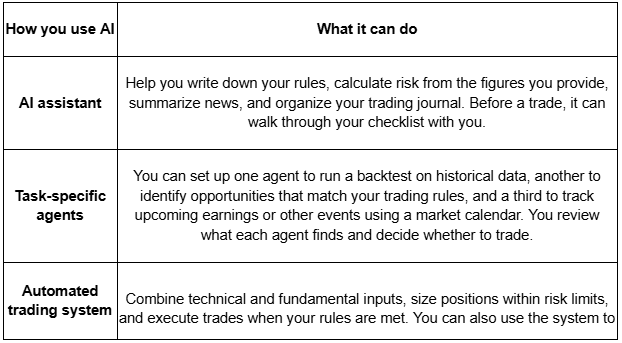
	Today, individual traders can use AI for parts of that work. How far they can take it depends on three things.
</p>
<ul>
<li dir="ltr">
<p dir="ltr" role="presentation">
			<strong>AI model</strong>: Models differ in how well they follow complex trading rules, write and debug code, and how much data they can review at once. For years of options quotes, you can ask AI to write a script that processes the dataset.<br />
			 
		</p>
</li>
<li dir="ltr">
<p dir="ltr" role="presentation">
			<strong>Data access</strong>: AI can help write a backtest. Testing an options strategy requires historical quotes for the strikes and expirations the strategy would have traded.<br />
			 
		</p>
</li>
<li dir="ltr">
<p dir="ltr" role="presentation">
			<strong>Broker access</strong>: You can automate alerts or prepare trades for manual review. To submit live orders automatically, your system needs a compatible broker connection and rules that define when it can act.<br />
			 
		</p>
</li>
</ul>
<p>
	<img decoding="async" alt="image.png" class="ipsImage ipsImage_thumbnailed" data-fileid="60082" data-ratio="55.14" data-unique="jawubqbyn" width="622" src="https://steadyoptions.com/uploads/monthly_2026_11/image.png.ef08d6c409462072b96e37f42cf1a952.png" />
</p>
<p>
	 
</p>
<p>
	For example, you might want to know what happens to call prices after a stock breaks out. AI can help you write a script that matches years of breakout signals to the historical options quotes available at the time. You can then compare how calls with different strikes and expirations performed over the next few trading days, without looking up every contract by hand.<br />
	 
</p>
<h3 dir="ltr">
	Integrate AI into your trading system<br />
</h3>
<p dir="ltr">
	You may come from a background in finance or investing and want to automate a trading strategy without knowing how to code. A few years ago, building an automated trading system often meant hiring a team of developers, explaining how you trade, and spending considerable time and money building and testing the software.<br />
	 
</p>
<p dir="ltr">
	Today, you can describe your trading rules in plain English and ask a model such as GPT‑6 Sol in ChatGPT or Claude Fable 5.2 to draft a script. This approach is often called vibe coding. Compare the generated code with your rules, then test a few trades you can verify by hand.
</p>
<p dir="ltr">
	<br />
	For more complex work, such as debugging a backtest that pulls quotes for both legs of an options spread, you can use OpenAI Codex or Anthropic’s Claude Code. These tools can work across multiple files and run tests. Ask them to show which tests they ran and check whether the results match what you expected.
</p>
<p dir="ltr">
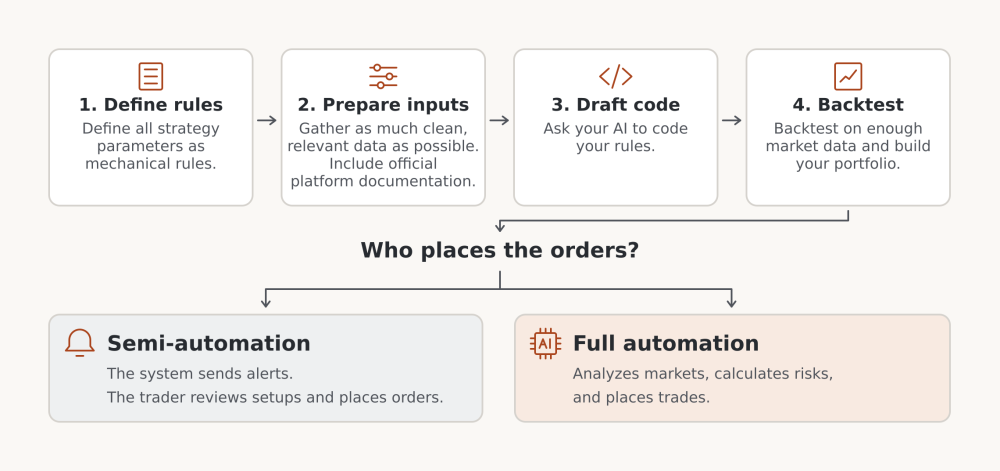
	Here’s how you can use these AI tools in your trading workflow:</p>
<p>	<img decoding="async" alt="image.png" class="ipsImage ipsImage_thumbnailed" data-fileid="60083" data-ratio="47.10" data-unique="p11i7m05k" width="1000" src="https://steadyoptions.com/uploads/monthly_2026_11/image.thumb.png.07d2b7bc5fe772ecef87c3732c8f2a14.png" />
</p>
<h3 dir="ltr">
	<br />
	Turn your trading decisions into rules<br />
</h3>
<p dir="ltr">
	Whether you trade trend following, mean reversion, or any other strategy, start with the decisions you want the system to make. Write down what triggers a trade, what you’ll trade, how much you’ll risk, and when you’ll exit or skip a setup. Include the indicators and analysis you already use, and spell out what you look for in each. If you want the system to place orders, define how it should handle those too.<br />
	 
</p>
<p dir="ltr">
	Suppose you want to buy a bull call spread after a stock breaks out. You buy one call and sell another at a higher strike, both with the same expiration. Here’s how you could turn that setup into rules.
</p>
<ul>
<li dir="ltr">
<p dir="ltr" role="presentation">
			<strong>Signal</strong>: The stock must close above the highest price it reached in the previous 20 trading sessions.
		</p>
</li>
<li dir="ltr">
<p dir="ltr" role="presentation">
			<strong>Entry</strong>: At 9:45 a.m. Eastern the next trading day, select the expiration closest to 30 days away, within a 25- to 35-day window. Buy the call with the strike nearest the stock price and sell the call with a strike $5 higher. Skip the setup if no expiration qualifies or either strike is unavailable.
		</p>
</li>
<li dir="ltr">
<p dir="ltr" role="presentation">
			<strong>Risk</strong>: Set a maximum net debit of $1.25 per share and a dollar risk budget per trade. Use that budget to decide how many spreads you can open. Skip the trade if even one spread would exceed the budget.
		</p>
</li>
<li dir="ltr">
<p dir="ltr" role="presentation">
			<strong>Exit</strong>: Attempt to close both legs together at 9:45 a.m. Eastern five trading sessions after entry. Decide in advance what the system should do if the closing order goes unfilled.
		</p>
</li>
</ul>
<p dir="ltr">
	Some decisions are harder to put into code. You might take profits when a move “looks tired,” based on what you’ve seen in similar trades. With partial automation, the system can alert you while you decide when to exit. If you want it to manage the exit too, describe what you see when momentum fades in terms the code can check, then test that rule.<br />
	 
</p>
<p dir="ltr">
	When you automate a strategy, you may give up some of the flexibility you had trading manually. A fixed exit can leave money on the table when you would have held a winning trade longer. It can also give back some gains when you would have spotted fading momentum and taken profits sooner.</p>
<p>	What you gain is a system that follows the same rules every time, cuts down on impulsive decisions driven by fear, greed, or FOMO, and frees you from having to watch every position. Judge the strategy over a series of trades. Look at whether it can produce a profit after costs, whether you can tolerate its drawdowns, and how much of your time it actually saves.<br />
	 
</p>
<p dir="ltr">
	Building your own options strategy? See how professional options traders plan and manage their trades. Explore SteadyOptions membership for options education and real-time trade alerts, with explanations of why the team enters, adjusts, and exits trades.<br />
	 
</p>
<h3 dir="ltr">
	Give AI the platform documentation and the right data<br />
</h3>
<p dir="ltr">
	Once your rules are written down, tell the AI where the code will run. Share the official documentation for your platform’s scripting language or your broker’s API, or ask the AI to find the pages relevant to what you’re building. Ask it to show where the code handles each rule so you can check how it translated your instructions.<br />
	 
</p>
<p dir="ltr">
	Give the AI a sample of your data so it can see how prices and timestamps are recorded. For the backtest itself, use as much clean, relevant history as you can get. In the breakout example, the stock’s price history tells you when the signal occurred. To estimate what it would have cost to open and close the spread, you need timestamped bid and ask quotes for both calls at the times specified in your rules. Cboe’s historical options quote data is one example.<br />
	 
</p>
<p dir="ltr">
	Ask the AI to write the code that matches the stock signal to the two option contracts and their quotes. Decide how old a quote can be before the script treats it as stale. If either leg has a missing or stale quote, have the script flag the setup for review. Give the AI two examples with known outcomes. In the first, the order fills at $1.25 or less. In the second, it remains unfilled because the backtest’s fill rules never show a fill at $1.25 or less while the order is open.<br />
	 
</p>
<h3 dir="ltr">
	From backtest to live trading<br />
</h3>
<h3 dir="ltr">
	Check individual trades before judging the results<br />
</h3>
<p dir="ltr">
	Open a few trades from the backtest and follow them from signal to exit. Did the code wait until the next session? Did it pick the right strikes and expiration? Did it respect the debit limit and attempt to close the spread at the right time?
</p>
<p dir="ltr">
	If a trade looks wrong, give AI the timestamp, the rule, the expected result, and what the code actually did. Rerun that case after the fix. Once the script follows your rules, you can start evaluating the strategy itself.<br />
	 
</p>
<h3 dir="ltr">
	Check whether the spread could have filled<br />
</h3>
<p dir="ltr">
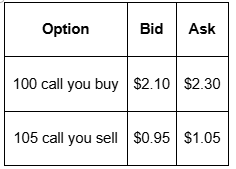
	Suppose the stock breaks out and your entry rules select the 100 call to buy and the 105 call to sell. Here’s what their quotes might look like at the scheduled entry time.</p>
<p>	<img decoding="async" alt="image.png" class="ipsImage ipsImage_thumbnailed" data-fileid="60084" data-ratio="71.61" data-unique="ob66bweua" width="236" src="https://steadyoptions.com/uploads/monthly_2026_11/image.png.40af4a5dda4731c5372efaf6ecbf56c7.png" />
</p>
<p>
	<span>The midpoint of the call you buy is $2.20. The midpoint of the call you sell is $1.00. Subtract one from the other and you get a $1.20 net debit per share.</span>
</p>
<p dir="ltr">
	 
</p>
<p dir="ltr">
	Buying at the displayed ask and selling at the displayed bid gives a $1.35 debit, above your $1.25 limit. A combined order could still fill at $1.25 or less. The midpoint alone gives you too little information to count it as a fill. If the order remains open, apply your fill rules to the quotes that follow.
</p>
<p dir="ltr">
	<br />
	That’s why the timestamp matters. In The Last 14 Minutes, SteadyOptions shows how a wide quote on one leg changed the calculated midpoint of a spread near the close.<br />
	 
</p>
<p dir="ltr">
	Once you’ve checked that the trades and fills follow your rules, review three numbers first.
</p>
<ul>
<li dir="ltr">
<p dir="ltr" role="presentation">
			<strong>Net return</strong>: How much did the strategy earn after commissions and fees?
		</p>
</li>
<li dir="ltr">
<p dir="ltr" role="presentation">
			<strong>Trade count</strong>: How many trades contributed to those results?
		</p>
</li>
<li dir="ltr">
<p dir="ltr" role="presentation">
			<strong>Maximum drawdown</strong>: How far did the account fall from a peak before recovering or reaching the end of the test?
		</p>
</li>
</ul>
<p dir="ltr">
	If you use a profit target and a stop, compare the planned reward with the amount at risk. This spread has a five-session exit and no fixed profit target, so look at the win rate alongside the average win and average loss after costs.<br />
	 
</p>
<p dir="ltr">
	If you trade across several stocks, test the positions together. Two spreads on stocks in the same sector can lose money at the same time.
</p>
<ul>
<li dir="ltr">
<p dir="ltr" role="presentation">
			<strong>Set risk limits</strong> for each trade and for all open positions combined.
		</p>
</li>
<li dir="ltr">
<p dir="ltr" role="presentation">
			<strong>Compare portfolio versions</strong> over the same period using net return, maximum drawdown, and the Sharpe ratio. Sharpe measures how much return you earned above the risk-free rate relative to how much your returns fluctuated.
		</p>
</li>
</ul>
<p dir="ltr">
	Test across market conditions that matter to your strategy. Set aside a later period before you adjust the rules, then use it once you’ve settled on a version. If you change the rules after seeing those results, use fresh data for the next independent check.
</p>
<p dir="ltr">
	<br />
	<img decoding="async" alt="image.png" class="ipsImage ipsImage_thumbnailed" data-fileid="60085" data-ratio="51.70" data-unique="fpn6w3v0k" width="1000" src="https://steadyoptions.com/uploads/monthly_2026_11/image.thumb.png.9b2582b88927f86410b3eb04c4d9f93c.png" />
</p>
<h3 dir="ltr">
	<br />
	Connect alerts to execution and test it on paper<br />
</h3>
<p dir="ltr">
	With semi-automation, a TradingView alert tells you when a breakout triggers. You can then check the spread’s price in your broker’s options chain and place the order yourself.<br />
	 
</p>
<p dir="ltr">
	TradingView can simulate Pine strategy orders. For live automation, a TradingView webhook sends the signal to an external service. At your scheduled entry time, the service checks quotes and risk limits, then submits the order through the broker’s API if those checks pass.<br />
	 
</p>
<p dir="ltr">
	Check that your broker supports placing both legs as a single order at a net limit price. Interactive Brokers supports spread orders through its Web API. Its paper simulator uses the best displayed quotes and has limited support for combo orders.<br />
	 
</p>
<p dir="ltr">
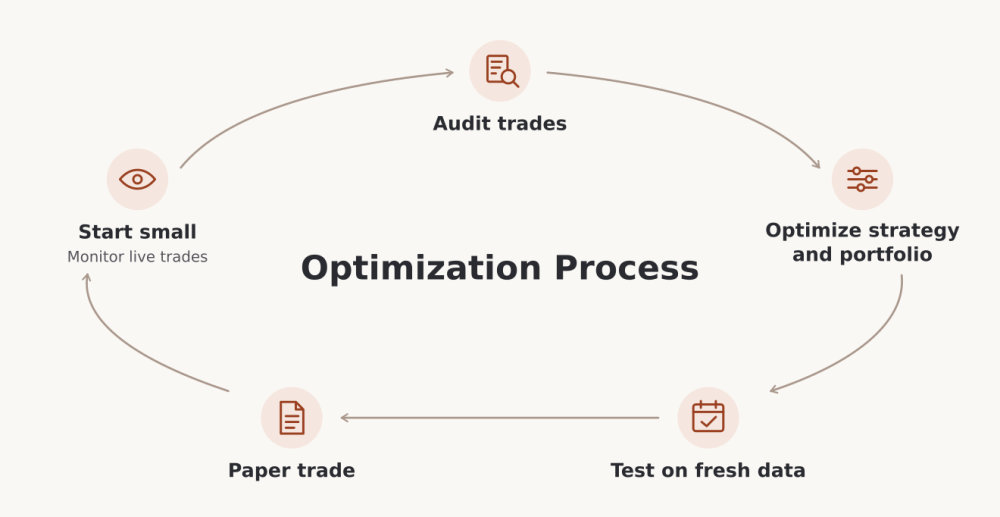
	A backtest applies your rules to historical data. Paper trading lets you watch the system respond as signals arrive. Check how it handles:
</p>
<ul>
<li dir="ltr">
<p dir="ltr" role="presentation">
			A rejected entry order.
		</p>
</li>
<li dir="ltr">
<p dir="ltr" role="presentation">
			An unfilled exit order.
		</p>
</li>
<li dir="ltr">
<p dir="ltr" role="presentation">
			A submission timeout. Check whether the broker received or filled the order before retrying.<br />
			 
		</p>
</li>
</ul>
<h3 dir="ltr">
	Start small and monitor what actually happens<br />
</h3>
<p dir="ltr">
	If you go live, start with a position size whose loss you can absorb. Check the first trades against your rules. If the chart and broker use different feeds, compare the symbol, session settings, timestamps, and prices before deciding why a signal or fill differed from the test.<br />
	 
</p>
<p dir="ltr">
	Keep a log of signals, submitted limits, actual fills, commissions, and orders that went unfilled. If far fewer orders fill within your $1.25 limit than the backtest assumed, pause new entries and see whether the quotes widened or your fill model was too optimistic.
</p>
<p dir="ltr">
	<br />
	Have a plan for open positions too. If a closing order remains unfilled as expiration approaches, decide how you’ll handle the spread and the risk of assignment on the short call. With American-style equity options, the short call can be assigned before expiration, especially just before the stock’s ex-dividend date. As market conditions change, review your rules and test any revisions before putting them into live use.<br />
	 
</p>
<h3 dir="ltr">
	Advantages and disadvantages of AI in trading<br />
</h3>
<p dir="ltr">
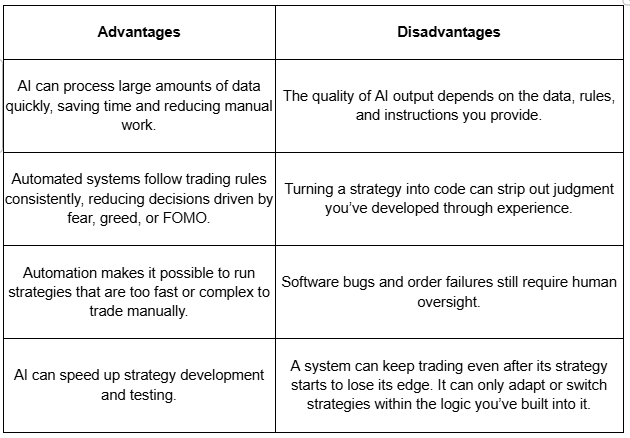
	AI can shorten the work between having an idea and seeing how it behaves in a test. The value depends on the job you give it and how easily you can check the result.
</p>
<p>
	<br />
	<img decoding="async" alt="image.png" class="ipsImage ipsImage_thumbnailed" data-fileid="60086" data-ratio="69.52" data-unique="cpx9xs1po" width="630" src="https://steadyoptions.com/uploads/monthly_2026_11/image.png.1487fb98ab4d34c97e0ac39ecc572a26.png" /><br />
	 
</p>
<h3 dir="ltr">
	Final thoughts<br />
</h3>
<p dir="ltr">
	AI is changing how traders and investors develop and test their strategies. You can use it to turn a trading idea into code, backtest your rules on years of historical data, and automate some or all of your trading process. Your experience still matters when you set the rules, decide how much to risk, and judge whether the results hold up.<br />
	 
</p>
<p dir="ltr">
	Start with one task you can check yourself. Compare two spreads, test a single entry rule, or automate an alert. Give the system more responsibility once you’ve seen how it handles the job and what happens when something goes wrong.<br />
	 
</p>
<p dir="ltr">
	Explore SteadyOptions membership for options education, trade ideas, and a community where you can see how traders plan entries, manage positions, and make exit decisions.<br />
	 
</p>
<h3 dir="ltr">
	FAQ<br />
</h3>
<h3 dir="ltr">
	Can I use AI for options trading without knowing how to code?<br />
</h3>
<p dir="ltr">
	Yes. You can use an AI assistant to compare contracts, organize a trade plan, or draft a script from rules you describe. If the script will submit orders, you need a way to check its behavior and troubleshoot problems before it handles real money.<br />
	 
</p>
<h3 dir="ltr">
	How can I compare two AI tools for options trading?<br />
</h3>
<p dir="ltr">
	Give both tools the same options chain and the same task. For example, ask each to identify which bull call spreads meet your strike, expiration, and debit rules. Check whether each tool picks the right contracts, shows its calculations, and flags missing quotes.<br />
	 
</p>
<h3 dir="ltr">
	Can AI help me review an options trade I already closed?<br />
</h3>
<p dir="ltr">
	Yes. Give it your original trade plan, both legs’ entry and exit fills, and the reason you closed the position. Ask it to point out where your execution differed from the plan. For example, it can help you spot that you paid more for the spread than you intended or closed it before your exit rule called for it.</p>
<p>	 
</p>
<p dir="ltr">
	<em>About the author: </em><em>Naoufal Seddik is a trader and financial writer with over six years of experience in financial markets. He covers forex, indices, stocks, and commodities. He works with the editorial team to create clear, accurate trading and investing content for readers of all experience levels. He is also a Top Rated Plus freelancer on Upwork.</em>
</p>
<p>
	<em>Upwork profile:<br />
	https://www.upwork.com/freelancers/~01900fde01a206f244</em>
</p>
<p dir="ltr">
	 
</p>
<p>
	 </p><p>The post <a rel="nofollow" href="https://girlsrockinvesting.com/2026/11/15/ai-in-options-trading-could-it-change-the-way-you-trade/">AI In Options Trading: Could It Change The Way You Trade?</a> appeared first on <a rel="nofollow" href="https://girlsrockinvesting.com">Girls Rock Investing</a>.</p>
]]></content>
		
			</entry>
		<entry>
		<author>
			<name>Girls Rock Investing</name>
							<uri>https://girlrocksinvesting.com</uri>
						</author>

		<title type="html"><![CDATA[Wall Street’s next big test is hiding in America’s shopping trolley]]></title>
		<link rel="alternate" type="text/html" href="https://girlsrockinvesting.com/2026/11/14/wall-streets-next-big-test-is-hiding-in-americas-shopping-trolley/" />

		<id>https://girlsrockinvesting.com/2026/11/14/wall-streets-next-big-test-is-hiding-in-americas-shopping-trolley/</id>
		<updated>2026-11-14T09:45:16Z</updated>
		<published>2026-11-14T09:45:16Z</published>
		<category scheme="https://girlrocksinvesting.com/" term="Ideas" />
		<summary type="html"><![CDATA[<p><img width="150" height="150" src="https://girlsrockinvesting.com/wp-content/uploads/2026/11/15-1-N2PsUJ-150x150.png" class="attachment-thumbnail size-thumbnail wp-post-image" alt="" decoding="async" loading="lazy" srcset="https://girlsrockinvesting.com/wp-content/uploads/2026/11/15-1-N2PsUJ-150x150.png 150w, https://girlsrockinvesting.com/wp-content/uploads/2026/11/15-1-N2PsUJ-585x585.png 585w" sizes="(max-width: 150px) 100vw, 150px" />Walmart and Target will report quarterly earnings next week, giving Wall Street a closer look at how American households are spending as holiday shopping gathers pace. Shoppers face familiar choices:&#8230;</p>
<p>The post <a rel="nofollow" href="https://girlsrockinvesting.com/2026/11/14/wall-streets-next-big-test-is-hiding-in-americas-shopping-trolley/">Wall Street’s next big test is hiding in America’s shopping trolley</a> appeared first on <a rel="nofollow" href="https://girlsrockinvesting.com">Girls Rock Investing</a>.</p>
]]></summary>

					<content type="html" xml:base="https://girlsrockinvesting.com/2026/11/14/wall-streets-next-big-test-is-hiding-in-americas-shopping-trolley/"><![CDATA[<img width="150" height="150" src="https://girlsrockinvesting.com/wp-content/uploads/2026/11/15-1-N2PsUJ-150x150.png" class="attachment-thumbnail size-thumbnail wp-post-image" alt="" decoding="async" loading="lazy" srcset="https://girlsrockinvesting.com/wp-content/uploads/2026/11/15-1-N2PsUJ-150x150.png 150w, https://girlsrockinvesting.com/wp-content/uploads/2026/11/15-1-N2PsUJ-585x585.png 585w" sizes="(max-width: 150px) 100vw, 150px" /><div><img decoding="async" width="1200" height="622" src="https://invezz-wp-media.lon1.digitaloceanspaces.com/2026/11/15-1.png" class="attachment-post-main size-post-main wp-post-image" alt="Walmart and Target earnings next week" data-attachmentid="984344" /></div>
<p>Walmart and Target will report quarterly earnings next week, giving Wall Street a closer look at how American households are spending as holiday shopping gathers pace.</p>
<p>Shoppers face familiar choices: switch to cheaper groceries, postpone buying a household appliance or wait for a discount before purchasing gifts. Those decisions can lift sales while squeezing profit on each purchase.</p>
<p>Target reports on Wednesday, 18 November, followed by Walmart on Thursday, 19 November. </p>
<p>Investors will be watching not simply how much consumers spend, but who is spending, what goes into their baskets and how much money retailers keep.</p>
<h2 class="wp-block-heading">More spending does not always mean stronger households</h2>
<p>A larger checkout bill is not necessarily a sign of prosperity. Prices can rise while customers buy fewer products, and stronger spending by wealthy households can conceal weaker demand elsewhere.</p>
<p>Alvarez &amp; Marsal&#8217;s consumer survey, released on 12 November, illustrates that divide. </p>
<p>The consultancy surveyed over 2,000 US consumers in late August and early September, finding that higher-income households planned to spend more over the holidays while lower-income respondents expected cuts across every holiday category.</p>
<p>“Dollars are likely to rise with prices and affluent spending, even as most households plan to do less,” the firm&#8217;s Fall 2026 Consumer Sentiment Survey concluded.</p>
<p>That is a forecast about shopping intentions, not a measure of purchases already made. It also helps explain why two retailers reporting growing sales might be serving very different customers.</p>
<p>The survey found that 49% of respondents wait for promotional events such as Black Friday or Cyber Monday, at least for big-ticket items. </p>
<p>Among shoppers trying to reduce grocery expenditure, 39% planned to switch to cheaper brands within their usual store.</p>
<h2 class="wp-block-heading">The same shopper poses different tests for Walmart and Target</h2>
<p>Walmart&#8217;s previous quarter offered one useful starting point. US comparable sales excluding fuel increased 2.6%, supported by 1.5% more transactions and a 1.1% higher average ticket.</p>
<p>The question next week is whether customers keep visiting and add toys, clothing and other discretionary goods alongside everyday essentials.</p>
<p>Target&#8217;s latest comparable sales grew 3.8%, driven mainly by a 3.6% rise in traffic rather than substantially bigger baskets. </p>
<p>Investors will look for repeat visits, demand across its merchandise categories and evidence that promotions are driving profitable purchases.</p>
<p>Comparable sales broadly capture growth from established stores and relevant online sales, rather than expansion through new outlets. </p>
<p>Each retailer has its own definition, making traffic, ticket size and the mix of products important alongside the headline percentage.</p>
<p>The discount that wins a shopper can prove costly. Gross margin measures the proportion of sales remaining after the cost of merchandise. </p>
<p>Aggressive markdowns might bring customers through the door while leaving less profit behind, particularly if retailers also carry excess inventory.</p>
<p>“Consumers are making discretionary trade-offs and starting their holiday shopping earlier,” said Mark Chambers, EY Americas retail sector leader.</p>
<p>Early promotions might encourage additional purchases. Equally, they could simply pull December spending into November, making holiday sales difficult to interpret until the full season has passed.</p>
<p>Walmart and Target therefore face a shared test of profitability, not an identical test of demand. Walmart needs to show that its value proposition produces earnings growth. </p>
<p>Target must demonstrate that more visits and appealing offers translate into sustainable margins.</p>
<h2 class="wp-block-heading">A resilient consumer can still disappoint Wall Street</h2>
<p>Caution does not mean Americans have stopped shopping. </p>
<p>“People express frustration and anger and disappointment — and then they go out and shop,” Eric Fisch, HSBC&#8217;s US head of retail and apparel, told Vogue Business.</p>
<p>That gap between mood and behaviour helps explain the National Retail Federation&#8217;s October forecast: holiday sales would rise 4.2% to $1.013 trillion during November and December. </p>
<p>The estimate excludes automobile dealers, petrol stations and restaurants, and concerns dollar sales, not the number of items bought.</p>
<p>Nor is every purchase an endorsement of a retailer&#8217;s pricing power. </p>
<p>Shoppers might spend on food and seasonal necessities while delaying furniture or electronics, or buy premium gifts only after sacrificing everyday extras. Changing categories can matter as much as the total bill.</p>
<p>Stock investors face expectations. A retailer could deliver solid growth yet disappoint if its share price already anticipates stronger results.</p>
<p>Another could rally on modest improvement if investors had feared worse.</p>
<p>Next week&#8217;s earnings will provide clues through comparable sales, transaction counts, gross margins, inventory and holiday guidance. </p>
<p>Management comments on promotions will matter especially: are retailers winning additional business, or paying too much to secure it?</p>
<p>The post Wall Street’s next big test is hiding in America’s shopping trolley appeared first on Invezz</p><p>The post <a rel="nofollow" href="https://girlsrockinvesting.com/2026/11/14/wall-streets-next-big-test-is-hiding-in-americas-shopping-trolley/">Wall Street’s next big test is hiding in America’s shopping trolley</a> appeared first on <a rel="nofollow" href="https://girlsrockinvesting.com">Girls Rock Investing</a>.</p>
]]></content>
		
			</entry>
		<entry>
		<author>
			<name>Girls Rock Investing</name>
							<uri>https://girlrocksinvesting.com</uri>
						</author>

		<title type="html"><![CDATA[Why the AI trade is hard to kill, but easy to frighten]]></title>
		<link rel="alternate" type="text/html" href="https://girlsrockinvesting.com/2026/11/14/why-the-ai-trade-is-hard-to-kill-but-easy-to-frighten/" />

		<id>https://girlsrockinvesting.com/2026/11/14/why-the-ai-trade-is-hard-to-kill-but-easy-to-frighten/</id>
		<updated>2026-11-14T09:44:44Z</updated>
		<published>2026-11-14T09:44:44Z</published>
		<category scheme="https://girlrocksinvesting.com/" term="Ideas" />
		<summary type="html"><![CDATA[<p><img width="150" height="150" src="https://girlsrockinvesting.com/wp-content/uploads/2026/11/G-20-0bnbW5-150x150.png" class="attachment-thumbnail size-thumbnail wp-post-image" alt="" decoding="async" loading="lazy" srcset="https://girlsrockinvesting.com/wp-content/uploads/2026/11/G-20-0bnbW5-150x150.png 150w, https://girlsrockinvesting.com/wp-content/uploads/2026/11/G-20-0bnbW5-585x585.png 585w" sizes="(max-width: 150px) 100vw, 150px" />The artificial intelligence investment boom has developed a familiar pattern: a new threat emerges, technology stocks sell off, and investors soon begin buying the dip. DeepSeek’s arrival in January 2025&#8230;</p>
<p>The post <a rel="nofollow" href="https://girlsrockinvesting.com/2026/11/14/why-the-ai-trade-is-hard-to-kill-but-easy-to-frighten/">Why the AI trade is hard to kill, but easy to frighten</a> appeared first on <a rel="nofollow" href="https://girlsrockinvesting.com">Girls Rock Investing</a>.</p>
]]></summary>

					<content type="html" xml:base="https://girlsrockinvesting.com/2026/11/14/why-the-ai-trade-is-hard-to-kill-but-easy-to-frighten/"><![CDATA[<img width="150" height="150" src="https://girlsrockinvesting.com/wp-content/uploads/2026/11/G-20-0bnbW5-150x150.png" class="attachment-thumbnail size-thumbnail wp-post-image" alt="" decoding="async" loading="lazy" srcset="https://girlsrockinvesting.com/wp-content/uploads/2026/11/G-20-0bnbW5-150x150.png 150w, https://girlsrockinvesting.com/wp-content/uploads/2026/11/G-20-0bnbW5-585x585.png 585w" sizes="(max-width: 150px) 100vw, 150px" /><div><img decoding="async" width="1200" height="622" src="https://invezz-wp-media.lon1.digitaloceanspaces.com/2026/11/G-20.png" class="attachment-post-main size-post-main wp-post-image" alt="wall street" data-attachmentid="984981" /></div>
<p>The artificial intelligence investment boom has developed a familiar pattern: a new threat emerges, technology stocks sell off, and investors soon begin buying the dip. </p>
<p>DeepSeek’s arrival in January 2025 challenged assumptions about the cost of developing advanced AI. </p>
<p>Nvidia fell nearly 17% in a day, losing about $593 billion in market value, before recovering around 8% the next session. </p>
<p>During the tariff turmoil in April 2025, the Nasdaq-100 suffered its fourth-worst two-day loss since 2007, before recording its second-best single-day gain over the same period on April 9, after the White House announced a 90-day pause in reciprocal tariffs.</p>
<p>More recently, the Nasdaq Composite fell 5.5% on November 5 as investors worried that Democratic victories in the US midterm elections could slow data-centre construction. </p>
<p>The index rebounded 2.7% on November 9, although falling oil prices also helped lift broader markets.</p>
<p>The rebounds have not erased all losses. </p>
<p>But the sequence captures the trade’s central tension: investors believe AI could transform businesses while questioning the valuations and financing behind it.</p>
<h2 class="wp-block-heading">Why does the AI trade keep coming back?</h2>
<p>For Louisa Loran, an executive adviser and global business strategist who previously worked at Google, the answer begins with demand. </p>
<p>“The AI investment boom has faced several existential threats, but none of them has touched what investors are actually betting on, which is use,” she said.</p>
<p>DeepSeek’s low-cost models raised concerns that cheaper systems could undermine the economics of US AI developers and reduce demand for high-end chips. </p>
<p>Loran argues that lower costs could instead encourage wider adoption. </p>
<p>“DeepSeek made AI cheaper, and lower access cost has always increased uptake in an industry, so it strengthened the case for adoption rather than weakening it,” she said.</p>
<p>Adoption, however, is not yet translating consistently into corporate profits. </p>
<p>A McKinsey survey published in August 2026 found that 80% of respondents said AI had improved individual productivity, while 37% reported at least some contribution to their organisation’s earnings before interest and taxes.</p>
<p>Loran said she had seen this lag while working with Google customers. </p>
<p>“Infrastructure scales at the speed of capital, while returns arrive at the speed at which organisations change how they work and make decisions,” she told <em><strong>Invezz</strong></em>. </p>
<p>Companies may build infrastructure before redesigning processes and training staff to capture its benefits.</p>
<p>Harry Hamann, founder of investment research firm InvestWealth, offered a financial explanation. </p>
<p>He said the market scares had not broken the revenue and cash-flow engines funding the largest technology companies. </p>
<p>The biggest spenders, he argued, have financed much of the build-out from existing businesses, allowing infrastructure orders to continue despite falling share prices.</p>
<p>Hamann separates short-term market movements from longer-term fundamentals. </p>
<p>“Over days, it is mostly positioning: crowded holdings, leverage and options hedging turn a headline into a 5% to 15% move. Over quarters, fundamentals decide, which is why every dip so far has been bought,” he told <em><strong>Invezz</strong></em>. </p>
<p>While Hamann’s framing relies on broad market mechanics rather than a quantitative decomposition of each pullback, it highlights a key divide between short-term trading and long-term capital allocation.</p>
<h2 class="wp-block-heading">Why are trillion-dollar companies swinging so violently?</h2>
<p>The dollar sums involved can make moves appear unprecedented. </p>
<p>A 5% decline in a company valued at $5 trillion erases $250 billion in market value. </p>
<p>But market capitalisation is the share price multiplied by all outstanding shares; a fall in that figure does not mean an equivalent amount of cash has left the stock.</p>
<p>The percentage moves still matter. Franklin Templeton Institute estimated that hyperscalers and AI-adjacent companies together made up nearly 46% of the S&amp;P 500’s market value as of September 30, 2026. </p>
<p>The figure includes companies supplying or adopting AI, not just businesses that sell AI products.</p>
<p>That concentration means a change in sentiment towards AI can affect a significant share of the broader market. </p>
<p>It can also magnify crowded trades, momentum strategies and leveraged positions. </p>
<p>The Bank of England’s July 2026 Financial Stability Report said high concentration, correlated momentum-driven positions and increased leverage could amplify a fall in AI-related share prices if investors reassessed the sector’s earnings prospects.</p>
<p>Options-market data provide a clearer picture of how investor positioning changed as technology stocks came under pressure.</p>
<p>In a November 2 analysis, Cboe Global Markets found that the proportion of stocks among the S&amp;P&#8217;s top 100 showing inverted call skew — a sign of unusually bullish options sentiment — had fallen from 44% in early October to 10%.</p>
<p>At the same time, retail put buying in mega-cap technology stocks on Cboe&#8217;s exchanges reached a year-to-date high, accounting for 34% of retail opening trades, compared with an average of 24%.</p>
<p>The figures suggested that investors were moving away from bullish bets on further gains and increasingly seeking protection against potential declines.</p>
<p>That shift became more pronounced during the November 5 sell-off. </p>
<p>In a follow-up analysis published on November 9, Cboe found that increases in S&amp;P 500 put skew and put convexity accounted for 5.5 points of the 11.5-point increase in the VIX that day.</p>
<p>Yet the rise in hedging demand did not translate into widespread expectations of a broader market sell-off. </p>
<p>Cboe&#8217;s COR1M implied correlation index reached just 22% on November 5, compared with a historical average of around 70% on days when the S&amp;P 500 fell 4% in a session over the previous two decades. </p>
<p>Five of the 11 S&amp;P 500 sectors also finished the week higher.</p>
<p>Cboe said the options market was still pricing a rotation out of AI and technology stocks rather than a broader market contagion. </p>
<p>The data point to a sharp change in investor positioning and demand for downside protection, but do not establish that options trading caused the underlying share-price declines.</p>
<p>These mechanics help explain why a headline can produce a larger move than the immediate change in earnings outlook. </p>
<p>Still, explaining the market mechanics behind violent swings does not prove that underlying valuations are safe from fundamental shocks.</p>
<p>On November 12, Nvidia shares tumbled as much as 14.3% intraday following CEO Jensen Huang’s sudden resignation amid an internal conduct and security probe. </p>
<p>Yet the stock recovered to close down just 4.3% after CFO Colette Kress was named interim CEO—while rival chipmakers AMD and Broadcom surged roughly 6% on the day. </p>
<p>That intraday reversal underscored how quickly governance uncertainty can be repriced in a central AI stock without breaking broader appetite for the sector&#8217;s hardware.&#8221;</p>
<p>Nor are large percentage declines in major indices unprecedented. The Nasdaq Composite fell 12.3% on March 16, 2020, during the Covid-19 market shock. </p>
<p>What makes today’s moves striking is the enormous market value attached to a concentrated group of AI-linked companies, not proof that markets have entered an entirely new category of volatility.</p>
<h2 class="wp-block-heading">When does volatility become dangerous?</h2>
<p>A share-price fall is not automatically a financial-stability event. </p>
<p>The risk grows if an AI repricing undermines debt used to finance data centres and chips, or spreads losses to lenders.</p>
<p>Professor Iwa Salami, professor of financial law and regulation at the University of East London, said both business concerns and investor behaviour contribute to volatility. </p>
<p>Worries about profits can trigger selling, while crowded ownership, borrowing and rapid efforts to reduce risk can intensify declines and affect the wider market.</p>
<p>Salami said a more serious warning would be companies spending heavily on AI for years without generating sufficient returns. </p>
<p>&#8220;Falling profits, mounting debt or a lasting drop in AI investment would be more worrying than a short-term fall in share prices. Regulators should also watch whether losses spread to banks and other financial institutions,&#8221; the professor told <em><strong>Invezz</strong></em>.</p>
<p>That concern is reflected in official assessments. </p>
<p>A survey of 20 market contacts included in the Federal Reserve&#8217;s May 2026 Financial Stability Report identified concerns about AI-related equity valuations and capital expenditure increasingly funded by debt. </p>
<p>The report clarified that these responses reflected the views of survey participants, not those of the Federal Reserve Board or the New York Fed.</p>
<p>The Bank of England said AI-related companies&#8217; use of credit markets had accelerated rapidly, spanning public markets, private credit, leveraged finance and structured finance. </p>
<p>It described the pace of investment as historically unprecedented, although it found little evidence so far that AI financing was crowding out other borrowers. </p>
<p>It warned that declining hyperscaler free cash flow and increasingly complex financing arrangements could create risks if earnings disappoint or refinancing conditions worsen.</p>
<p>The Bank for International Settlements said financial-stability risks from the AI boom appeared moderate, but warned that its sustainability hinged on companies meeting high earnings expectations. </p>
<p>It also noted that equity prices had moved considerably ahead of debt-market valuations.</p>
<p>The AI trade has so far survived shocks to assumptions about model costs, trade policy and political support for infrastructure. </p>
<p>But resilience should not be confused with immunity. </p>
<p>AI may become more widely used even if some companies have overbuilt, borrowed too heavily or paid too much for infrastructure. </p>
<p>The technology can succeed while particular investments fail.</p>
<p>For investors, the question is whether companies financing AI’s expansion can earn returns that justify the capital committed. </p>
<p>For regulators, it is whether the debt links built around it could transmit a correction into the wider economy. </p>
<p>The next scare may pass, as previous ones have. The test will be whether the cash flows and financing behind the build-out remain intact.</p>
<p><strong><em>AI disclosure:</em></strong><em> AI tools assisted with research and drafting of this piece. An Invezz editor reviewed the facts, sources, and wording before publication. Any opinions or analysis are Invezz’s, not those of an automated system.</em></p>
<p>The post Why the AI trade is hard to kill, but easy to frighten appeared first on Invezz</p><p>The post <a rel="nofollow" href="https://girlsrockinvesting.com/2026/11/14/why-the-ai-trade-is-hard-to-kill-but-easy-to-frighten/">Why the AI trade is hard to kill, but easy to frighten</a> appeared first on <a rel="nofollow" href="https://girlsrockinvesting.com">Girls Rock Investing</a>.</p>
]]></content>
		
			</entry>
		<entry>
		<author>
			<name>Girls Rock Investing</name>
							<uri>https://girlrocksinvesting.com</uri>
						</author>

		<title type="html"><![CDATA[Evening digest: oil heads for weekly decline, Tesla SpaceX merger talks advance]]></title>
		<link rel="alternate" type="text/html" href="https://girlsrockinvesting.com/2026/11/13/evening-digest-oil-heads-for-weekly-decline-tesla-spacex-merger-talks-advance/" />

		<id>https://girlsrockinvesting.com/2026/11/13/evening-digest-oil-heads-for-weekly-decline-tesla-spacex-merger-talks-advance/</id>
		<updated>2026-11-13T21:32:07Z</updated>
		<published>2026-11-13T21:32:07Z</published>
		<category scheme="https://girlrocksinvesting.com/" term="Ideas" />
		<summary type="html"><![CDATA[<p><img width="150" height="150" src="https://girlsrockinvesting.com/wp-content/uploads/2026/11/Oil-flowing-through-pipes-4Nr8vn-150x150.png" class="attachment-thumbnail size-thumbnail wp-post-image" alt="" decoding="async" loading="lazy" srcset="https://girlsrockinvesting.com/wp-content/uploads/2026/11/Oil-flowing-through-pipes-4Nr8vn-150x150.png 150w, https://girlsrockinvesting.com/wp-content/uploads/2026/11/Oil-flowing-through-pipes-4Nr8vn-585x585.png 585w" sizes="(max-width: 150px) 100vw, 150px" />Oil prices edged higher on Friday as signs of a growing global supply surplus and easing concerns over further military escalation in the Middle East weighed on the market. Meanwhile,&#8230;</p>
<p>The post <a rel="nofollow" href="https://girlsrockinvesting.com/2026/11/13/evening-digest-oil-heads-for-weekly-decline-tesla-spacex-merger-talks-advance/">Evening digest: oil heads for weekly decline, Tesla SpaceX merger talks advance</a> appeared first on <a rel="nofollow" href="https://girlsrockinvesting.com">Girls Rock Investing</a>.</p>
]]></summary>

					<content type="html" xml:base="https://girlsrockinvesting.com/2026/11/13/evening-digest-oil-heads-for-weekly-decline-tesla-spacex-merger-talks-advance/"><![CDATA[<img width="150" height="150" src="https://girlsrockinvesting.com/wp-content/uploads/2026/11/Oil-flowing-through-pipes-4Nr8vn-150x150.png" class="attachment-thumbnail size-thumbnail wp-post-image" alt="" decoding="async" loading="lazy" srcset="https://girlsrockinvesting.com/wp-content/uploads/2026/11/Oil-flowing-through-pipes-4Nr8vn-150x150.png 150w, https://girlsrockinvesting.com/wp-content/uploads/2026/11/Oil-flowing-through-pipes-4Nr8vn-585x585.png 585w" sizes="(max-width: 150px) 100vw, 150px" /><div><img decoding="async" width="1200" height="622" src="https://invezz-wp-media.lon1.digitaloceanspaces.com/2026/11/Oil-flowing-through-pipes.png" class="attachment-post-main size-post-main wp-post-image" alt="Oil flowing through pipes" data-attachmentid="979452" /></div>
<p>Oil prices edged higher on Friday as signs of a growing global supply surplus and easing concerns over further military escalation in the Middle East weighed on the market. </p>
<p>Meanwhile, US producer inflation rose less than expected in October, although persistent price pressures continued to complicate the Federal Reserve&#8217;s policy outlook.</p>
<h2 class="wp-block-heading">Oil prices head for second weekly decline</h2>
<p>Oil prices gained on Friday; however, Brent and West Texas Intermediate (WTI) crude are on track for a second consecutive weekly decline.</p>
<p>Brent futures fell 0.13% to $95.94 a barrel, while WTI declined 0.09% to $88.81. </p>
<p>Both benchmarks were set to lose around 2% for the week, following declines of 16% and 13%, respectively, in the previous week.</p>
<p>The market has shifted from concerns about supply shortages to fears of a potential surplus. </p>
<p>An International Energy Agency report released on Friday pointed to an increase in the global oil surplus, while lower geopolitical risks also weighed on prices.</p>
<p>US crude and fuel inventories also increased last week, reflecting softer demand for refined products and higher oil imports, according to the Energy Information Administration.</p>
<p>However, risks to shipments through the Strait of Hormuz remain. </p>
<p>Iran&#8217;s military said four oil tankers were hit by explosions in the waterway on Thursday, while Yemen&#8217;s Iran-backed Houthis claimed attacks on Saudi oil infrastructure. </p>
<h2 class="wp-block-heading">US PPI rises less than expected in October</h2>
<p>US wholesale prices increased 0.3% in October, below the 0.4% forecast by economists surveyed by Dow Jones, according to the Bureau of Labor Statistics.</p>
<p>Core PPI, which excludes food and energy, also rose 0.3%, in line with expectations. </p>
<p>However, the annual headline rate accelerated to 6.5%, its highest level since November 2022.</p>
<p>Goods prices were a major contributor to the increase. </p>
<p>Final demand goods prices rose 0.5% during the month, while the goods index increased 10.2% year over year, its largest annual gain since October 2022.</p>
<p>Services prices rose 0.2%, with transportation and warehousing contributing to the increase. Truck freight transportation prices climbed 3.9%.</p>
<p>The figures offered some relief after consumer inflation also came in hotter than expected earlier in the week. </p>
<p>However, the annual acceleration in producer prices and broader cost pressures could complicate the Fed&#8217;s next decision.</p>
<p>Markets were pricing in a December rate increase, with the CME FedWatch tool showing an 87.7% probability of a 25-basis-point hike and a 12.3% chance of a 50-basis-point move.</p>
<h2 class="wp-block-heading">Gold struggles despite softer PPI reading</h2>
<p>Gold prices fell on Friday after the producer inflation report came in below expectations. </p>
<p>However, the modest recovery did little to offset the previous session&#8217;s steep losses.</p>
<p>Spot gold fell 0.03% to $3,875.14 an ounce, after briefly reaching $3,922.97 following the PPI release. US gold futures for December delivery fell 0.14% to 3,880.10.</p>
<p>Bullion fell 3% on Thursday, reaching a more-than-one-year low as higher oil prices and hotter-than-expected consumer inflation strengthened concerns about interest rates remaining elevated.</p>
<p>Gold was down around 4.5% for the week, putting it on course for its worst weekly performance since early June.</p>
<p>Higher interest rates tend to reduce the appeal of non-yielding assets such as gold. Silver and platinum also declined on Friday, while palladium advanced.</p>
<h2 class="wp-block-heading">Tesla and SpaceX merger talks gather pace</h2>
<p>Tesla and SpaceX could announce a merger as soon as December, according to a Bloomberg report published on Thursday.</p>
<p>The potential deal would combine Tesla&#8217;s electric vehicles, energy storage and robotics businesses with SpaceX&#8217;s rockets, satellites and artificial intelligence operations. </p>
<p>Based on their valuations of more than $1.9 trillion and around $1.5 trillion, respectively, the combined company could be worth approximately $3.4 trillion to $3.5 trillion.</p>
<p>Boards and advisers are reportedly discussing the terms, including the exchange ratio for Tesla shareholders and the governance structure. </p>
<p>An announcement could still be delayed until early 2027.</p>
<p>Elon Musk, who leads both companies and is their largest shareholder, has previously described a merger as a good idea, citing potential synergies in AI, chip design, robotics and orbital computing.</p>
<p>However, significant hurdles remain. </p>
<p>Tesla&#8217;s China business, which accounts for roughly 20% of its revenue and a larger share of its earnings and free cash flow, could complicate the transaction.</p>
<p>JPMorgan has identified Chinese regulatory approval as the biggest obstacle. </p>
<p>Any deal would also require clearances across multiple jurisdictions and approval from Tesla shareholders, while the special committees overseeing discussions must demonstrate that their decisions serve shareholders&#8217; interests.</p>
<p>The post Evening digest: oil heads for weekly decline, Tesla SpaceX merger talks advance appeared first on Invezz</p><p>The post <a rel="nofollow" href="https://girlsrockinvesting.com/2026/11/13/evening-digest-oil-heads-for-weekly-decline-tesla-spacex-merger-talks-advance/">Evening digest: oil heads for weekly decline, Tesla SpaceX merger talks advance</a> appeared first on <a rel="nofollow" href="https://girlsrockinvesting.com">Girls Rock Investing</a>.</p>
]]></content>
		
			</entry>
		<entry>
		<author>
			<name>Girls Rock Investing</name>
							<uri>https://girlrocksinvesting.com</uri>
						</author>

		<title type="html"><![CDATA[Microsoft stock steadies after global outage as AI competition intensifies]]></title>
		<link rel="alternate" type="text/html" href="https://girlsrockinvesting.com/2026/11/13/microsoft-stock-steadies-after-global-outage-as-ai-competition-intensifies/" />

		<id>https://girlsrockinvesting.com/2026/11/13/microsoft-stock-steadies-after-global-outage-as-ai-competition-intensifies/</id>
		<updated>2026-11-13T21:31:44Z</updated>
		<published>2026-11-13T21:31:44Z</published>
		<category scheme="https://girlrocksinvesting.com/" term="Ideas" />
		<summary type="html"><![CDATA[<p><img width="150" height="150" src="https://girlsrockinvesting.com/wp-content/uploads/2026/11/Microsoft-logo-on-a-monitor-screen-MUqx5u-150x150.png" class="attachment-thumbnail size-thumbnail wp-post-image" alt="" decoding="async" loading="lazy" srcset="https://girlsrockinvesting.com/wp-content/uploads/2026/11/Microsoft-logo-on-a-monitor-screen-MUqx5u-150x150.png 150w, https://girlsrockinvesting.com/wp-content/uploads/2026/11/Microsoft-logo-on-a-monitor-screen-MUqx5u-585x585.png 585w" sizes="(max-width: 150px) 100vw, 150px" />Microsoft shares recovered on Friday after a global outage disrupted its Outlook, Teams and Copilot services, affecting users across more than 70 countries. The incident has renewed concerns about businesses&#8217;&#8230;</p>
<p>The post <a rel="nofollow" href="https://girlsrockinvesting.com/2026/11/13/microsoft-stock-steadies-after-global-outage-as-ai-competition-intensifies/">Microsoft stock steadies after global outage as AI competition intensifies</a> appeared first on <a rel="nofollow" href="https://girlsrockinvesting.com">Girls Rock Investing</a>.</p>
]]></summary>

					<content type="html" xml:base="https://girlsrockinvesting.com/2026/11/13/microsoft-stock-steadies-after-global-outage-as-ai-competition-intensifies/"><![CDATA[<img width="150" height="150" src="https://girlsrockinvesting.com/wp-content/uploads/2026/11/Microsoft-logo-on-a-monitor-screen-MUqx5u-150x150.png" class="attachment-thumbnail size-thumbnail wp-post-image" alt="" decoding="async" loading="lazy" srcset="https://girlsrockinvesting.com/wp-content/uploads/2026/11/Microsoft-logo-on-a-monitor-screen-MUqx5u-150x150.png 150w, https://girlsrockinvesting.com/wp-content/uploads/2026/11/Microsoft-logo-on-a-monitor-screen-MUqx5u-585x585.png 585w" sizes="(max-width: 150px) 100vw, 150px" /><div><img decoding="async" width="1200" height="622" src="https://invezz-wp-media.lon1.digitaloceanspaces.com/2026/11/Microsoft-logo-on-a-monitor-screen.png" class="attachment-post-main size-post-main wp-post-image" alt="Microsoft logo on a monitor screen" data-attachmentid="986390" /></div>
<p>Microsoft shares recovered on Friday after a global outage disrupted its Outlook, Teams and Copilot services, affecting users across more than 70 countries. </p>
<p>The incident has renewed concerns about businesses&#8217; dependence on centralised cloud services, while intensifying competition in artificial intelligence adds to the pressure on the technology giant.</p>
<h2 class="wp-block-heading">Microsoft apologises as outage disrupts services</h2>
<p>Microsoft shares MSFT rose approximately 0.18% to $523.94 on Friday, recovering from a decline of more than 2% in premarket trading.</p>
<p>The outage, which began on Thursday, November 12, affected several Microsoft 365 services, including Outlook email, Teams and the Copilot AI assistant. </p>
<p>According to Downdetector, users across more than 70 countries reported disruptions.</p>
<p>The incident affected services used by more than 430 million people, alongside governments and organisations worldwide. </p>
<p>Microsoft engineers worked for more than 20 hours to address the disruption.</p>
<p>In its latest updates, Microsoft apologised for the outage, saying it was &#8220;deeply sorry&#8221; for the disruption caused since Thursday. </p>
<p>In a 3:05 p.m. EST update, the company said it did not yet have a timeline for full recovery.</p>
<p>Earlier, Microsoft had said it was seeing &#8220;broad recovery and stability&#8221; across its services.</p>
<p>&#8220;Given the scale of demand, we restored services gradually, validating stability at each stage. While this took longer, it helped ensure a stable restoration,&#8221; the company said in an earlier update.</p>
<p>Microsoft also dismissed speculation that the outage was linked to technical issues involving artificial intelligence agents. </p>
<p>It said the incident was caused by a technical issue and was not related to cybersecurity or AI agents. </p>
<p>The company plans to publish a full post-incident report after completing its review.</p>
<h2 class="wp-block-heading">Outage highlights dependence on cloud services</h2>
<p>The disruption has drawn attention to the risks associated with businesses relying heavily on a small number of major technology providers.</p>
<p>Microsoft&#8217;s cloud-based model allows organisations to avoid the costs of operating and maintaining their own email servers and infrastructure. </p>
<p>However, a prolonged outage at a major provider can affect large numbers of businesses simultaneously.</p>
<p>Microsoft&#8217;s second-quarter availability for its Microsoft 365 workplace applications was reported at 99.994% globally, making prolonged disruptions relatively rare.</p>
<p>Nevertheless, the incident could encourage companies to invest more in backup services and continuity arrangements.</p>
<p>Providers such as US cybersecurity firm Mimecast offer continuity services that allow users to send and receive emails through temporary inboxes when their primary systems become unavailable. </p>
<p>Privacy-focused technology company Proton also offers standby email accounts that businesses can activate during disruptions.</p>
<p>According to a study by Oxford Economics and Splunk, unplanned outages of critical digital business systems cost Global 2000 companies an average of $15,000 per minute.</p>
<p>While continuity services have traditionally attracted deadline-sensitive industries such as law, the latest disruption could encourage wider adoption among accounting firms, hospitals and other regulated businesses.</p>
<p>Geopolitical tensions have also increased concerns about dependence on US technology providers, particularly in Europe. </p>
<p>The outage highlighted how technical failures alone can disrupt access to essential digital services.</p>
<h2 class="wp-block-heading">AI competition adds to pressure on Microsoft</h2>
<p>The outage comes at a challenging time for Microsoft as investors assess its position in the artificial intelligence market.</p>
<p>Recent reports about OpenAI&#8217;s latest figures have raised questions about its competitive position relative to Anthropic. </p>
<p>Microsoft owns a 24% stake in OpenAI and has a smaller investment in Anthropic.</p>
<p>Anthropic also recently introduced a new suite of office tools, adding to competition in a market where Microsoft has a significant presence through its productivity software and Copilot assistant.</p>
<p>Investors will be watching Microsoft&#8217;s upcoming Ignite conference for updates on its AI strategy and cloud platform Azure.</p>
<p>Citi analyst Tyler Radke said the event could reinforce confidence in the company&#8217;s AI growth outlook.</p>
<p>&#8220;We expect the event to reinforce confidence in Microsoft&#8217;s AI growth narrative,&#8221; Radke said in a research note.</p>
<p>The conference could provide investors with further insight into Microsoft&#8217;s cloud and Copilot developments as the company seeks to maintain its position in an increasingly competitive AI market.</p>
<p><strong><em>AI disclosure:</em></strong><em> AI tools assisted with research and drafting of this piece. An Invezz editor reviewed the facts, sources and wording before publication. Any opinions or analysis are Invezz’s, not those of an automated system.</em></p>
<p>The post Microsoft stock steadies after global outage as AI competition intensifies appeared first on Invezz</p><p>The post <a rel="nofollow" href="https://girlsrockinvesting.com/2026/11/13/microsoft-stock-steadies-after-global-outage-as-ai-competition-intensifies/">Microsoft stock steadies after global outage as AI competition intensifies</a> appeared first on <a rel="nofollow" href="https://girlsrockinvesting.com">Girls Rock Investing</a>.</p>
]]></content>
		
			</entry>
		<entry>
		<author>
			<name>Girls Rock Investing</name>
							<uri>https://girlrocksinvesting.com</uri>
						</author>

		<title type="html"><![CDATA[Nvidia stock outlook: Can shares recover after Jensen Huang&#8217;s exit?]]></title>
		<link rel="alternate" type="text/html" href="https://girlsrockinvesting.com/2026/11/13/nvidia-stock-outlook-can-shares-recover-after-jensen-huangs-exit/" />

		<id>https://girlsrockinvesting.com/2026/11/13/nvidia-stock-outlook-can-shares-recover-after-jensen-huangs-exit/</id>
		<updated>2026-11-13T20:30:42Z</updated>
		<published>2026-11-13T20:30:42Z</published>
		<category scheme="https://girlrocksinvesting.com/" term="Ideas" />
		<summary type="html"><![CDATA[<p><img width="150" height="150" src="https://girlsrockinvesting.com/wp-content/uploads/2026/11/G-qd8GJ1-150x150.png" class="attachment-thumbnail size-thumbnail wp-post-image" alt="" decoding="async" loading="lazy" srcset="https://girlsrockinvesting.com/wp-content/uploads/2026/11/G-qd8GJ1-150x150.png 150w, https://girlsrockinvesting.com/wp-content/uploads/2026/11/G-qd8GJ1-585x585.png 585w" sizes="(max-width: 150px) 100vw, 150px" />Nvidia shares NVDA remained under pressure on Friday, falling 2.17% at the time of writing after recovering from an intraday decline of 4.6%. The latest losses followed a 4.3% drop&#8230;</p>
<p>The post <a rel="nofollow" href="https://girlsrockinvesting.com/2026/11/13/nvidia-stock-outlook-can-shares-recover-after-jensen-huangs-exit/">Nvidia stock outlook: Can shares recover after Jensen Huang&#8217;s exit?</a> appeared first on <a rel="nofollow" href="https://girlsrockinvesting.com">Girls Rock Investing</a>.</p>
]]></summary>

					<content type="html" xml:base="https://girlsrockinvesting.com/2026/11/13/nvidia-stock-outlook-can-shares-recover-after-jensen-huangs-exit/"><![CDATA[<img width="150" height="150" src="https://girlsrockinvesting.com/wp-content/uploads/2026/11/G-qd8GJ1-150x150.png" class="attachment-thumbnail size-thumbnail wp-post-image" alt="" decoding="async" loading="lazy" srcset="https://girlsrockinvesting.com/wp-content/uploads/2026/11/G-qd8GJ1-150x150.png 150w, https://girlsrockinvesting.com/wp-content/uploads/2026/11/G-qd8GJ1-585x585.png 585w" sizes="(max-width: 150px) 100vw, 150px" /><div><img decoding="async" width="1200" height="622" src="https://invezz-wp-media.lon1.digitaloceanspaces.com/2026/11/G.png" class="attachment-post-main size-post-main wp-post-image" alt="Jensen Huang Presents NVIDIA Vision" data-attachmentid="974894" /></div>
<p>Nvidia shares NVDA remained under pressure on Friday, falling 2.17% at the time of writing after recovering from an intraday decline of 4.6%. </p>
<p>The latest losses followed a 4.3% drop on Thursday after founder and longtime CEO Jensen Huang resigned amid reports concerning his personal relationships.</p>
<p>The departure has raised questions about Nvidia&#8217;s leadership succession, corporate culture and exposure to potential regulatory scrutiny. </p>
<p>The company is also on track for its largest weekly market capitalisation decline on record.</p>
<p>However, analysts remain divided on the stock&#8217;s outlook, with some arguing that its valuation offers an attractive entry point while others warn that the controversy could create longer-term risks.</p>
<h2 class="wp-block-heading">Nvidia valuation and earnings could support a recovery</h2>
<p>Despite the recent selloff, Nvidia shares trade at less than 12 times estimated earnings for the next 12 months, according to Barron&#8217;s analysis. </p>
<p>A modest improvement in its valuation multiple could therefore support a significant recovery.</p>
<p>The company&#8217;s upcoming third-quarter earnings report on Tuesday could provide an important catalyst.</p>
<p>Investors will closely monitor whether Nvidia reiterates its forecast for 70% revenue growth in fiscal 2028. </p>
<p>Any confirmation could help restore confidence in its growth prospects. </p>
<p>Additional share buybacks could also support the stock if its valuation remains depressed.</p>
<p>XTB analyst Kathleen Brooks said Nvidia&#8217;s upcoming results would be closely watched following Huang&#8217;s resignation.</p>
<p>While Brooks expects another strong earnings report, with revenue potentially exceeding the $108 billion estimate, she said the company&#8217;s forward guidance would be more important for determining the stock&#8217;s direction.</p>
<p>Yorkville Ives also maintained a bullish view, arguing that Nvidia remains the clear leader in GPU chips for the AI industry, with an estimated two-to-three-year advantage over its nearest competitor.</p>
<p>The analysts believe the current valuation does not fully reflect the company&#8217;s position and see Colette Kress as a credible leader during the transition.</p>
<h2 class="wp-block-heading">Leadership uncertainty remains an overhang</h2>
<p>The absence of an immediate permanent successor is another challenge for Nvidia shares.</p>
<p>Chief Financial Officer Colette Kress is viewed as a potential interim leader, although the company is expected to require technical leadership for its next phase of growth.</p>
<p>Potential successors mentioned in early speculation include Ian Buck, Nvidia&#8217;s vice president of hyperscale and high-performance computing, and Arm Holdings CEO Rene Haas.</p>
<p>Yorkville Ives also identified Apple CEO Tim Cook as a possible outside candidate, describing him as a dark-horse option given Nvidia&#8217;s importance to the broader US technology industry.</p>
<p>A clearer succession plan or announcement of a shortlist could help reduce uncertainty surrounding the company&#8217;s future direction.</p>
<p>Morgan Stanley reiterated its overweight rating on Nvidia but lowered its price target to $267 from $300.</p>
<p>The firm acknowledged that Huang&#8217;s resignation, the absence of an immediate permanent successor and China-related regulatory risks represent setbacks. </p>
<p>However, it maintained that Nvidia&#8217;s underlying business remains strong and that the risk-reward profile is attractive even under more conservative assumptions.</p>
<h2 class="wp-block-heading">China scrutiny and corporate culture pose risks</h2>
<p>The biggest threat to Nvidia&#8217;s recovery could come from further developments surrounding the controversy that led to Huang&#8217;s departure.</p>
<p>Treasury Secretary Scott Bessent questioned on Friday whether Nvidia had a sufficiently robust system to prevent its chips from reaching China through intermediaries. </p>
<p>Speaking to CNBC, he said he expected the company&#8217;s board to conduct a thorough investigation.</p>
<p>Huang has reportedly agreed to testify before Congress, where lawmakers are interested in determining whether his reported relationship with a suspected Chinese intelligence agent resulted in the transfer of intellectual property or advanced hardware to China.</p>
<p>Hendi Susanto, portfolio manager at Gabelli Funds, said the next developments could depend on the findings of investigations and the level of scrutiny from Washington, particularly concerning China and export controls.</p>
<p>Truist also downgraded Nvidia to hold from buy, citing concerns about the company&#8217;s culture and the possibility that GPUs may have reached Chinese companies and government entities.</p>
<p>These concerns could affect future revenue prospects if they lead to tighter restrictions or additional regulatory action.</p>
<p><strong><em>AI disclosure:</em></strong><em> AI tools assisted with research and drafting of this piece. An Invezz editor reviewed the facts, sources and wording before publication. Any opinions or analysis are Invezz’s, not those of an automated system.</em></p>
<p>The post Nvidia stock outlook: Can shares recover after Jensen Huang&#8217;s exit? appeared first on Invezz</p><p>The post <a rel="nofollow" href="https://girlsrockinvesting.com/2026/11/13/nvidia-stock-outlook-can-shares-recover-after-jensen-huangs-exit/">Nvidia stock outlook: Can shares recover after Jensen Huang&#8217;s exit?</a> appeared first on <a rel="nofollow" href="https://girlsrockinvesting.com">Girls Rock Investing</a>.</p>
]]></content>
		
			</entry>
		<entry>
		<author>
			<name>Girls Rock Investing</name>
							<uri>https://girlrocksinvesting.com</uri>
						</author>

		<title type="html"><![CDATA[Apple stock gains as Bernstein highlights safe-haven appeal amid AI selloff]]></title>
		<link rel="alternate" type="text/html" href="https://girlsrockinvesting.com/2026/11/13/apple-stock-gains-as-bernstein-highlights-safe-haven-appeal-amid-ai-selloff/" />

		<id>https://girlsrockinvesting.com/2026/11/13/apple-stock-gains-as-bernstein-highlights-safe-haven-appeal-amid-ai-selloff/</id>
		<updated>2026-11-13T19:29:46Z</updated>
		<published>2026-11-13T19:29:46Z</published>
		<category scheme="https://girlrocksinvesting.com/" term="Ideas" />
		<summary type="html"><![CDATA[<p><img width="150" height="150" src="https://girlsrockinvesting.com/wp-content/uploads/2026/11/Screenshot-11-4CZLCK-150x150.png" class="attachment-thumbnail size-thumbnail wp-post-image" alt="" decoding="async" loading="lazy" srcset="https://girlsrockinvesting.com/wp-content/uploads/2026/11/Screenshot-11-4CZLCK-150x150.png 150w, https://girlsrockinvesting.com/wp-content/uploads/2026/11/Screenshot-11-4CZLCK-585x585.png 585w" sizes="(max-width: 150px) 100vw, 150px" />Apple shares rose 0.99% on Friday, even as broader technology stocks came under pressure following Nvidia&#8217;s decline. The iPhone maker is increasingly attracting investors seeking exposure to a relatively defensive&#8230;</p>
<p>The post <a rel="nofollow" href="https://girlsrockinvesting.com/2026/11/13/apple-stock-gains-as-bernstein-highlights-safe-haven-appeal-amid-ai-selloff/">Apple stock gains as Bernstein highlights safe-haven appeal amid AI selloff</a> appeared first on <a rel="nofollow" href="https://girlsrockinvesting.com">Girls Rock Investing</a>.</p>
]]></summary>

					<content type="html" xml:base="https://girlsrockinvesting.com/2026/11/13/apple-stock-gains-as-bernstein-highlights-safe-haven-appeal-amid-ai-selloff/"><![CDATA[<img width="150" height="150" src="https://girlsrockinvesting.com/wp-content/uploads/2026/11/Screenshot-11-4CZLCK-150x150.png" class="attachment-thumbnail size-thumbnail wp-post-image" alt="" decoding="async" loading="lazy" srcset="https://girlsrockinvesting.com/wp-content/uploads/2026/11/Screenshot-11-4CZLCK-150x150.png 150w, https://girlsrockinvesting.com/wp-content/uploads/2026/11/Screenshot-11-4CZLCK-585x585.png 585w" sizes="(max-width: 150px) 100vw, 150px" /><div><img decoding="async" width="1920" height="1080" src="https://invezz-wp-media.lon1.digitaloceanspaces.com/2026/10/Screenshot-11.png" class="attachment-post-main size-post-main wp-post-image" alt="Apple iPhone Duo" data-attachmentid="948915" /></div>
<p>Apple shares rose 0.99% on Friday, even as broader technology stocks came under pressure following Nvidia&#8217;s decline. </p>
<p>The iPhone maker is increasingly attracting investors seeking exposure to a relatively defensive technology business amid uncertainty surrounding artificial intelligence (AI) stocks, according to Bernstein analysts.</p>
<p>In a report published Thursday, Bernstein analysts led by Mark Newman said Apple had become less correlated with its large-cap technology peers and was increasingly trading alongside high-quality consumer companies.</p>
<p>&#8220;With little correlation to tech peers, Apple now trades in line with high quality consumer stocks,&#8221; the analysts said.</p>
<p>The assessment comes as Nvidia faces leadership uncertainty following reports surrounding CEO Jensen Huang, while concerns about the substantial capital expenditure requirements of AI infrastructure continue to weigh on technology stocks.</p>
<h2 class="wp-block-heading">Apple gains safe-haven appeal as AI spending weighs on tech</h2>
<p>Unlike several other Magnificent Seven companies, Apple has relatively modest capital expenditure requirements. </p>
<p>Its capital expenditure accounts for less than 2% of revenue, compared with the hundreds of billions of dollars being committed by major technology companies to AI infrastructure.</p>
<p>Bernstein described Apple as a consumer compounder, noting that its revenue growth, earnings generation and free cash flow profile increasingly resemble those of established consumer businesses.</p>
<p>The brokerage reiterated its outperform rating on Apple and maintained a $380 price target, implying approximately 7% upside from Thursday&#8217;s closing price.</p>
<p>Apple trades at around 37 times its expected earnings per share for 2027, roughly twice the broader market&#8217;s forward earnings multiple. </p>
<p>Among companies with market capitalizations above $200 billion and expected EPS growth below 15%, only Costco, Walmart and General Electric also trade at forward price-to-earnings multiples above 30.</p>
<p>However, Apple&#8217;s projected annual revenue growth through 2029 is approximately 9%, compared with 7% for Costco and 5% for Walmart.</p>
<p>Bernstein also highlighted Apple&#8217;s estimated 3.1% free cash flow yield and expected share repurchases equivalent to 3% of its market capitalization in 2027 and 3.2% in 2028.</p>
<h2 class="wp-block-heading">iPhone demand and services offer growth opportunities</h2>
<p>Apple&#8217;s operating performance continues to provide support for its valuation. </p>
<p>In the fourth quarter of fiscal 2026, iPhone revenue increased 17% year over year to $57.6 billion, despite supply constraints.</p>
<p>The company reported September-quarter revenue records for iPhone and record upgrades worldwide, including in the US, China and India.</p>
<p>The launch of iPhone Duo, alongside the iPhone 18 Pro and Pro Max, has expanded its product portfolio and created additional upgrade opportunities.</p>
<p>AI also represents a potential growth driver. </p>
<p>Apple&#8217;s planned improvements to Siri, including personalized assistance and contextual awareness, could encourage customers to upgrade to newer devices. </p>
<p>The company may also generate additional revenue by offering expanded access to advanced server-based AI capabilities.</p>
<p>Its Services business provides another monetization opportunity. </p>
<p>With more than 2.5 billion active devices worldwide, Apple has a substantial installed base for services such as Apple Pay, iCloud+, Apple Music and Apple TV. </p>
<p>The expansion of bundled services and the introduction of Apple Pay in India and advertising on Apple Maps could support further growth.</p>
<h2 class="wp-block-heading">Rising memory costs and supply constraints pose risks</h2>
<p>Despite its defensive characteristics, Apple faces several operational challenges.</p>
<p>The company expects gross margin to decline to 45%-46% in the first quarter of fiscal 2027, compared with 47.9% in the fourth quarter of fiscal 2026. </p>
<p>Rising memory prices and expenses related to Siri AI are expected to contribute to the decline.</p>
<p>Apple also continues to face supply constraints involving advanced semiconductor manufacturing capacity and memory components. </p>
<p>While advanced-node constraints are easing, memory shortages could affect Mac and iPad availability during the December quarter.</p>
<p>Regulatory scrutiny of its App Store business model and third-party licensing arrangements presents another risk.</p>
<p>Apple expects Services revenue growth to moderate to 8%-9% in the first quarter of fiscal 2027, compared with 10% in the preceding quarter, partly reflecting licensing-related and foreign-exchange headwinds.</p>
<p>These pressures could test Apple&#8217;s ability to sustain its premium valuation even as investors increasingly view the company as a defensive alternative within the technology sector.</p>
<p><strong><em>AI disclosure:</em></strong><em> AI tools assisted with research and drafting of this piece. An Invezz editor reviewed the facts, sources and wording before publication. Any opinions or analysis are Invezz’s, not those of an automated system.</em></p>
<p>The post Apple stock gains as Bernstein highlights safe-haven appeal amid AI selloff appeared first on Invezz</p><p>The post <a rel="nofollow" href="https://girlsrockinvesting.com/2026/11/13/apple-stock-gains-as-bernstein-highlights-safe-haven-appeal-amid-ai-selloff/">Apple stock gains as Bernstein highlights safe-haven appeal amid AI selloff</a> appeared first on <a rel="nofollow" href="https://girlsrockinvesting.com">Girls Rock Investing</a>.</p>
]]></content>
		
			</entry>
		<entry>
		<author>
			<name>Girls Rock Investing</name>
							<uri>https://girlrocksinvesting.com</uri>
						</author>

		<title type="html"><![CDATA[Why are Micron, SK Hynix, and SanDisk stocks falling on Friday?]]></title>
		<link rel="alternate" type="text/html" href="https://girlsrockinvesting.com/2026/11/13/why-are-micron-sk-hynix-and-sandisk-stocks-falling-on-friday-2/" />

		<id>https://girlsrockinvesting.com/2026/11/13/why-are-micron-sk-hynix-and-sandisk-stocks-falling-on-friday-2/</id>
		<updated>2026-11-13T17:27:45Z</updated>
		<published>2026-11-13T17:27:45Z</published>
		<category scheme="https://girlrocksinvesting.com/" term="Ideas" />
		<summary type="html"><![CDATA[<p><img width="150" height="150" src="https://girlsrockinvesting.com/wp-content/uploads/2026/10/image-138-krO72C-150x150.png" class="attachment-thumbnail size-thumbnail wp-post-image" alt="" decoding="async" loading="lazy" srcset="https://girlsrockinvesting.com/wp-content/uploads/2026/10/image-138-krO72C-150x150.png 150w, https://girlsrockinvesting.com/wp-content/uploads/2026/10/image-138-krO72C-585x585.png 585w" sizes="(max-width: 150px) 100vw, 150px" />Memory stocks including Micron, SK Hynix and SanDisk suffered losses on Friday as continued weakness in Nvidia weighed on semiconductor shares and intensified concerns about the sustainability of the artificial&#8230;</p>
<p>The post <a rel="nofollow" href="https://girlsrockinvesting.com/2026/11/13/why-are-micron-sk-hynix-and-sandisk-stocks-falling-on-friday-2/">Why are Micron, SK Hynix, and SanDisk stocks falling on Friday?</a> appeared first on <a rel="nofollow" href="https://girlsrockinvesting.com">Girls Rock Investing</a>.</p>
]]></summary>

					<content type="html" xml:base="https://girlsrockinvesting.com/2026/11/13/why-are-micron-sk-hynix-and-sandisk-stocks-falling-on-friday-2/"><![CDATA[<img width="150" height="150" src="https://girlsrockinvesting.com/wp-content/uploads/2026/10/image-138-krO72C-150x150.png" class="attachment-thumbnail size-thumbnail wp-post-image" alt="" decoding="async" loading="lazy" srcset="https://girlsrockinvesting.com/wp-content/uploads/2026/10/image-138-krO72C-150x150.png 150w, https://girlsrockinvesting.com/wp-content/uploads/2026/10/image-138-krO72C-585x585.png 585w" sizes="(max-width: 150px) 100vw, 150px" /><div><img decoding="async" width="1200" height="622" src="https://invezz-wp-media.lon1.digitaloceanspaces.com/2026/11/image-63.png" class="attachment-post-main size-post-main wp-post-image" alt="Micron SK Hynix memory chips" data-attachmentid="985850" /></div>
<p>Memory stocks including Micron, SK Hynix and SanDisk suffered losses on Friday as continued weakness in Nvidia weighed on semiconductor shares and intensified concerns about the sustainability of the artificial intelligence trade.</p>
<p>Micron MU and SK Hynix fell around 5% each, while SanDisk plunged 8%.</p>
<p>Nvidia slipped more than 4%, dragging the Philadelphia Semiconductor Index down over 5%.</p>
<p>The losses were considerably steeper than those in the broader market, with the Nasdaq falling 1.4% and the S&amp;P 500 losing nearly 0.8%.</p>
<p>The selloff came even as October&#8217;s producer price index (PPI) data came in softer than expected. </p>
<p>However, headline PPI accelerated 6.5% annually, up 0.2 percentage points and marking its highest annual rate since November 2022.</p>
<h2 class="wp-block-heading">Nvidia uncertainty spills over into memory stocks</h2>
<p>The turmoil surrounding Nvidia has raised questions about the broader AI trade, given the chipmaker&#8217;s central role in the industry&#8217;s expansion and its financial relationships with several companies across the ecosystem.</p>
<p>Investors are increasingly weighing concerns about AI infrastructure spending, debt financing, and the returns on massive capital investments.</p>
<p>Prolonged uncertainty around Nvidia could put additional pressure on valuations across the semiconductor sector.</p>
<p>China adds another layer of uncertainty. </p>
<p>Tighter US restrictions on advanced chips could accelerate domestic semiconductor substitution while making it harder for Chinese cloud companies to access sophisticated computing technology.</p>
<p>Memory stocks were already under pressure before Friday&#8217;s decline. </p>
<p>Micron has lost around 21% over the past month, while SK Hynix is down approximately 18%. </p>
<p>The stocks also suffered a sell-off following Democratic victories in both houses of Congress, amid concerns that the political outcome could slow data centre construction across the US.</p>
<p>According to Charu Chanana, chief investment strategist at Saxo, further trouble at Nvidia could particularly affect SK Hynix and Micron.</p>
<p>SK Hynix&#8217;s leading position as a supplier of high-bandwidth memory (HBM) for Nvidia leaves it exposed to potential disruptions in the chipmaker&#8217;s product roadmap.</p>
<p>However, demand for advanced memory from other AI platforms could remain strong, providing some support to the stock.</p>
<p>For Micron, Nvidia-related delays could affect near-term demand expectations for advanced memory. </p>
<p>Nevertheless, competing AI accelerator platforms also require high-performance memory, which could help cushion the impact.</p>
<h2 class="wp-block-heading">SanDisk faces additional NAND pricing concerns</h2>
<p>SanDisk suffered a steeper decline, with shares falling 8% on Friday and losing more than 42% over the past month.</p>
<p>The latest pressure followed a warning from Kioxia about a potential surge in NAND flash prices, raising fresh questions about competitive pricing dynamics and the sustainability of SanDisk&#8217;s elevated gross margins.</p>
<p>Also, the company&#8217;s data centre business, which generated the bulk of its recent revenue growth, is heavily dependent on AI infrastructure spending linked to Nvidia&#8217;s GPU ecosystem. </p>
<p>Any perceived threat to Nvidia&#8217;s strategic continuity could therefore translate into uncertainty over future NAND flash demand.</p>
<p>However, Evercore ISI remains optimistic about SanDisk&#8217;s longer-term prospects.</p>
<p>The brokerage reiterated its Outperform rating and $2,500 price target on Wednesday, arguing that investors are underestimating structural changes in the memory chipmaker&#8217;s business.</p>
<p>The firm held investor meetings with CEO David Goeckeler and head of investor relations Ivan Donaldson over the past two days.</p>
<p>“We think investors remain overly focused on how long NAND pricing can stay elevated rather than appreciating the structural changes to SNDK’s model,” Evercore wrote.</p>
<p>Management sees a changing NAND market in which suppliers manage output to match demand rather than simply maximise production. </p>
<p>Price increases have now lasted around six quarters, compared with roughly two quarters historically. </p>
<p>Gross margins above 80% also reduce suppliers&#8217; incentive to chase market share.</p>
<p>Evercore believes SanDisk&#8217;s multi-year supply agreements, which include committed demand, price floors and ceilings, and financial guarantees, could limit downside risks during a future downturn.</p>
<p>The brokerage also said data centre demand remained robust, with customers seeking additional supply for AI systems being deployed now. </p>
<p>A shift towards more durable, specialised memory could further tighten industry supply.</p>
<p>“NBMs + supply discipline should support more durable profitability, while AI demand + HBF provide incremental growth opportunities,” the firm said.</p>
<p><strong><em>AI disclosure:</em></strong><em> AI tools assisted with research and drafting of this piece. An Invezz editor reviewed the facts, sources and wording before publication. Any opinions or analysis are Invezz’s, not those of an automated system.</em></p>

<p>The post Why are Micron, SK Hynix, and SanDisk stocks falling on Friday? appeared first on Invezz</p><p>The post <a rel="nofollow" href="https://girlsrockinvesting.com/2026/11/13/why-are-micron-sk-hynix-and-sandisk-stocks-falling-on-friday-2/">Why are Micron, SK Hynix, and SanDisk stocks falling on Friday?</a> appeared first on <a rel="nofollow" href="https://girlsrockinvesting.com">Girls Rock Investing</a>.</p>
]]></content>
		
			</entry>
	</feed>