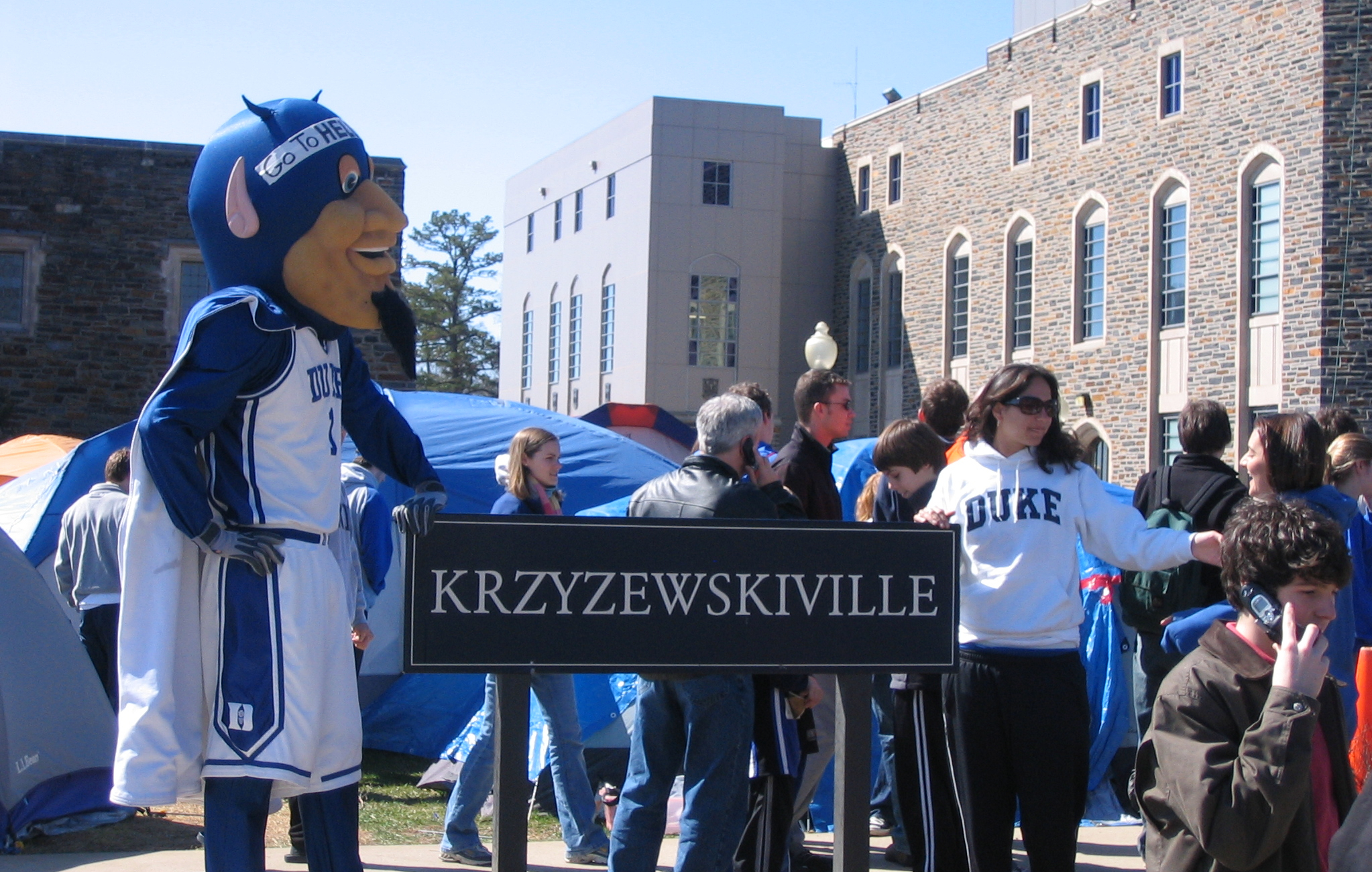
In January of 2026, just like every January since 1986, a basketball Brigadoon will rise on Duke’s campus. This village, locally known as “Krzyzewskiville,” exists for just a few short weeks every year, and then disappears. But while it lives, it is a beehive of activity, with surprisingly specific and aggressively enforced rules. K-Ville is not just a place, but a student-organized system of governance with its own rules, enforcement, and dispute resolution mechanisms. Elinor Ostrom herself couldn’t have come up with a better example of an emergent institution to create and enforce property rights to a common pool resource.
K-Ville was created as an orderly way to ration access to “free” student basketball tickets to “The UNC Game.” This Manichean struggle of “good” (Duke) versus the “living embodiment of evil on earth” (UNC) is the hottest ticket on campus most years. (The game is always scheduled for late February or early March, and so the January tradition works backward from the game date.) The StubHub price of the non-student tickets is a good measure of the value of what is being given away: buying tickets costs at least $2,000, and can cost $5,000 each or more, depending on the teams’ records and the quality of the seats.
Of course, the student seats are directly courtside, so what economists call the “shadow price” — the cost of the ticket if it could be sold — is at least several thousand dollars. Yet Duke gives these tickets to students on a first-come, first-served basis, for free. Why?
Duke (though nominally a “non-profit”) makes every effort to maximize revenue. Students are required to buy the meal plan, and to pay for a dorm room, at least for the first three years. So why would Duke turn generous and pass up well over two million dollars in revenue — 1,200 student seats in the prime “Student Section” (Section 17), at $2,000 each, conservatively — just to give the seats away?
The answer is interesting. But to get to the answer, we’ll need to review some history.
Origins
Duke basketball tickets are free to enrolled students with current, valid IDs who line up. But the number of seats is limited, so the line can get long. In 1986, a Duke senior and fourteen friends extended the usual “line up overnight” ritual by showing up two nights in advance.
According to The Duke Chronicle:
‘It was common for people to line up hours before a game,’ said Kimberly Reed, Trinity ’86, who was one of the first tenters. ‘We were playing quarters one night at Mirecourt and joking about how early we were going to line up for the ’86 [University of North Carolina at Chapel Hill] game. Finally, someone said, ‘Why don’t we just pitch a tent?’ After a few rounds of quarters, it began to sound like a good idea.’
Reed and about 15 of her friends, many of whom were members of the Air Force ROTC, rented a tent from U-Haul and set up camp in front of Cameron in March 1986.
‘We were going to ask permission…, but then we just decided to ask forgiveness later,’ she said. The adventurous fans set up four tents in front of Cameron on Thursday for the Saturday game against UNC, and word began to spread around campus. By Friday, other tents began to pop up.
‘Someone took a cardboard box and wrote Krzyzewskiville on it,’ Reed said. And so the tent city was named.
The timing was no accident: Between 1986 and 1994, Duke made seven Final Fours in nine years. More students wanted tickets than there were tickets available, by quite a bit, at least at a zero price. Of course, Duke could have charged for tickets, or used a lottery, but queuing was already the custom, and it stuck. But after 1986 the swelling demand to see the UNC game meant that kids had to line up for days, and (before long) weeks.
January in North Carolina’s Piedmont is not polar, but daytime highs average in the 40°s F, nighttime lows can dip well below freezing, and it rains a lot. Still, Cameron Indoor Stadium — roughly 9,300 seats, with about 2,500 reserved for students overall (with most of those in the more uncool, sedate Sections 18, and 19 not the most desirable Section 17) — was small enough to create a predictable, iterated problem that had to be solved every year: far more students wanted seats in Section 17 than were available. Early attempts at informal queuing were chaotic. Students camped without rules, disputes broke out about order, and many felt that the system rewarded only those who were willing to engage in opportunism or outright disruption.
In response, students themselves worked out, through trial and error each year, a more orderly process. They still lined up, but they formalized their place in line and rules of minimum occupancy, all overseen by “Line Monitors.” A tent by itself doesn’t hold your place in line; “tent checks” are performed randomly by Line Monitors. You get one “miss,” but if a student misses a Tent Check twice, they are out. Alternatively, if a tent as a whole has too few occupants present then that tent is removed and its fans disqualified. Students can also be disqualified for “excessive” drinking or obvious drunkenness (passing out, vomiting), but this rule has been enforced selectively.
By the 1990s, the system included tiers of participation — black tenting, blue tenting, and white tenting — each corresponding to different levels of commitment and different rewards in line order. It’s worth looking at the details.
Inside the Queuing System Itself
At its heart, K-Ville is a queuing system built around time and commitment rather than money. Groups of students (twelve per tent, at the start) register to camp out in K-Ville, with place in line determined by performance on a written test, as described below. Once tent order is determined, each tent unit must maintain a certain number of occupants, twenty-four hours a day. Line monitors, drawn from the student body in a “hyper-competitive” process designed by students themselves, enforce compliance by conducting random checks, sometimes in the middle of the night. DSG has legislated an explicit constitution for K-Ville, a set of rules that make the process (mostly) clear.
- Black tenting, the most rigorous, begins in early January and requires nearly continuous presence until the day before the game.
- Blue tenting begins later, with somewhat less stringent occupancy requirements.
- White tenting, beginning still later, requires the least commitment but comes with correspondingly lower priority in line.
On game day, students are admitted in the order and then color of their tents, until the available seats are exhausted. While all the seats in the student section are “good seats,” only the Black Tent denizens will be able to get in the front rows at the center of the court, which are the most desirable seats. This creates a clear correspondence between cost and reward: the more time students are willing to spend in line, the better their seats, fostering a meritocracy of endurance. Again, tickets could be auctioned, but the goal is not to select based on wealth, but on a fierce zealotry for the team. By using time as the currency rather than money, Duke students reinforce the principle that participation in fandom requires actual fanaticism.
The Problem of Fairness
Fairness is central to the design of K-Ville, and the rules are published. Line Monitors ensure compliance, though of course there are some complaints of excessive zeal in enforcement (few Duke students use “fascist” as a political description, but it is a common description of Line Monitors). The tier system allows for self-selection: those who are most dedicated (or most willing to endure discomfort) can camp longest, while others can choose a lighter commitment and still secure some chance of entry. The result is a system perceived as legitimate because it balances effort, transparency, and equal opportunity.
What makes K-Ville interesting is its emergent, student-governed nature: a community facing a scarcity problem managed to develop rules, enforcement mechanisms, and sanctions, all without any plan or formal intention. But there is one formal, designed or “laid on” rule: Place in line among Black Tent residents is determined by an examination. This innovation is quite interesting for two reasons.
First, queuing is economically inefficient. Students “pay” for seats with time and discomfort, which could otherwise be devoted to study, work, or leisure. An auction would be efficient, but such a system privileges the ability to pay over devotion. K-Ville’s governors wanted to limit the inefficiency of an open-ended “rent-seeking” contest, while preserving queuing’s signal about depth of fan loyalty.
Second, many organizations have independently stumbled across the value of initiation and elite membership rights. Creating difficulty of acquisition, even if that difficulty is artificial, can enhance the value of the thing acquired, especially if possession of that thing is highly public.
In light of these two influences, DSG has formally limited the amount of time that someone can wait in line, reducing the inefficiency implied by the first principle. And it has created an initiation right that sorts applicants by informed fanaticism, and by depth of knowledge. They use a lengthy and challenging examination: the Duke Basketball “Black Tenting Entry Test”.
The test differs each year, but it generically tests for whether the student/applicants can write down (from memory!) the names, position, and hometown of the Duke players. They also have to name the opponents played in all the Duke games so far that season, the scores of those games, and Duke’s overall won-lost record. Then the test moves to aggressively specific and truly “trivial” questions. Just one example, from the actual 2023 test:
Which team did Duke play against in a “secret scrimmage” before the season began? In what city did they play? What was the final score? (2 pts each; 6 pts total).
The answers (I had to look it up) were University of Houston, in Houston, and Duke lost 61-50.
These questions are not circulated in advance; they are not multiple choice, and there is no partial credit. The cutoff in recent years has been a score of 75 out of 100 possible points, meaning that at least two thirds of the applicants fail, and are not allowed a Black Tent. There are only 70 Black Tents allowed, and each tent has 12 occupants, though some of those may be disqualified even if the tent itself makes it through to the end. K-Ville starts with 100 tents total, and 12 students in each tent.
That’s 1,200 people who start the “tenting” experience each year, though by the end 300 or more of those folks may have been disqualified or moved to “Flex” or “Waitlist” tents with no guarantee of being seated.
K-Ville as an Emergent Order
F.A. Hayek would have called K-Ville an “emergent order.” Rules are not imposed from the outside; they evolve as individuals interact over time. Participants in a process learn from past successes and failures, and generate working rules that are known, followed, and enforced by participants themselves.
As Elinor Ostrom pointed out, “Working rules are the set of rules to which participants would make reference if asked to explain and justify their actions.” That’s interesting, because it means that the rules evolve from practice and trial and error, but then are written down after newcomers ask for an explanation.
The problem facing Duke students had three aspects: First, more people wanted tickets (after 1986, at least) than could get seats. Queuing for multiple days was chaotic, and there were incidents that led to frustration.
Second, the tribal experience of showing commitment by face-painting, elaborate coordinated chants and signs, and other rituals was collectively more enjoyable if all the participants are “real fans.” This “public good” aspect was intuitively understood by the students, even those who could never have defined a public good in technical economic terms. Using price or auctions would not have resulted in the same fan sorting.
Third, the first two considerations tended to lead to very inefficient “rent-seeking” contests, where it would be necessary to wait in line for more and more time, making the chances of unpleasantness, line-jumping, and perhaps even violence even greater. So some lottery or contest was necessary to limit the dead-weight losses of queueing (since auctions were off the table).
The solution the students have devised involves explicit and publicly recognized, an enforceable property right to “place in line,” based on tent number. But the extent of rent-seeking to obtain initial tent number is limited by having an “entry test,” an objective measure that is at least correlated with knowledge of the history and folkways of Duke basketball.
There are other benefits, as well. “Tenting” is a rite of passage for Duke students; many do it at least once, just for the experience. There is folk wisdom (though I could find no definitive source) that students who “tent” at least once are more likely later to attend reunions for alumni, and to make large donations to the Duke Endowment or other campus causes. As a whole, then, it is clear why Duke “gives students tickets for free” rather than by auction, even though an auction would generate immediate revenue. The shared identity of “Cameron Crazies”, both while enrolled and later, is an important part of a Duke student’s identity, and their commitment as alumni.
Kville has risen again. Black tenting started January 18; blue tenting starts January 28. The tents are full, and anticipation is growing.