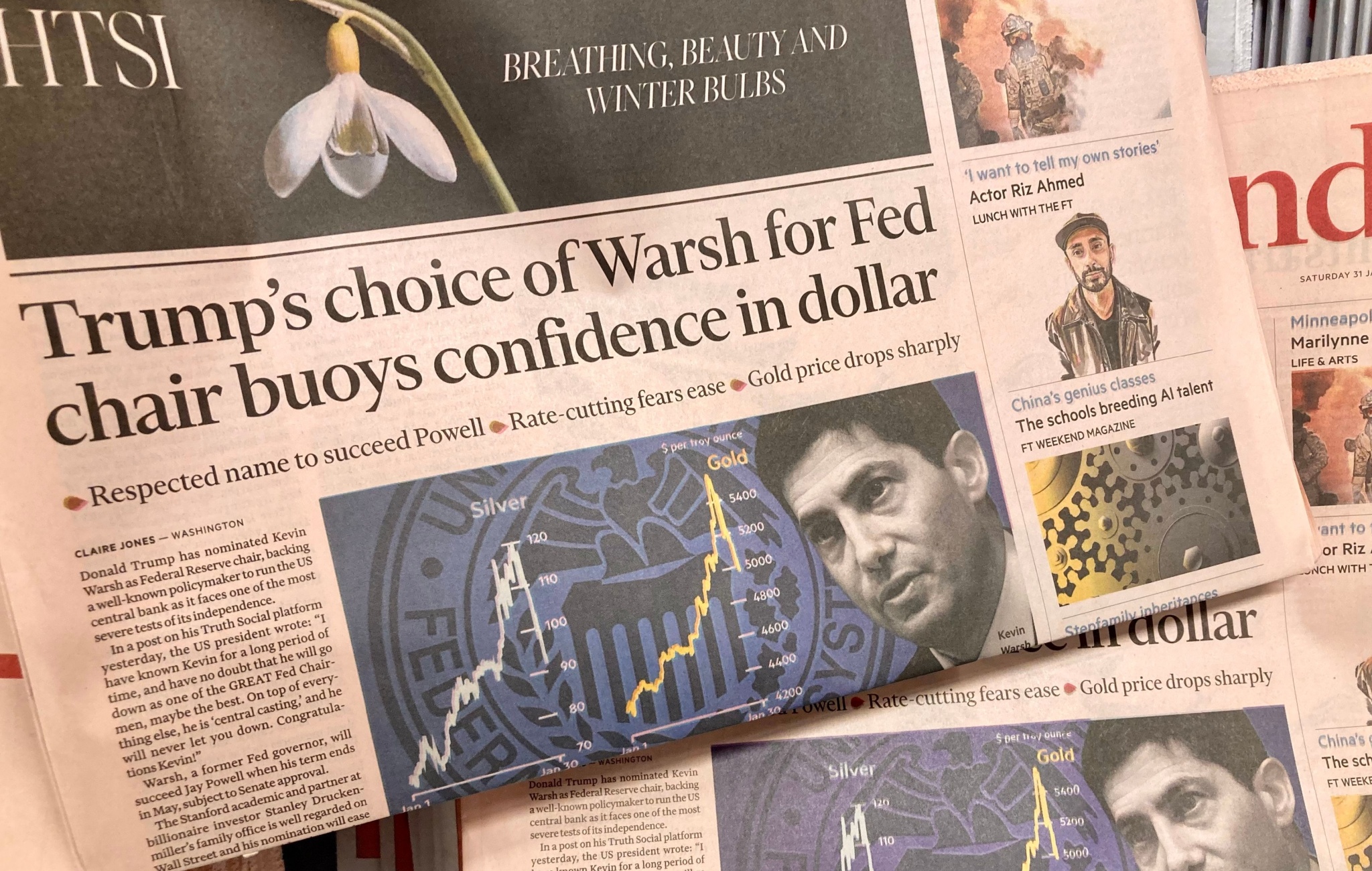
The nomination of Kevin Warsh to replace Jerome Powell as Federal Reserve Chair has many people wondering: What makes a good Fed chair? The answer, it turns out, depends on the environment in which the chair will operate.
The characteristics that matter most for running an independent central bank differ from those for a central bank under pressure from political actors. Understanding this distinction is important for evaluating the president’s nominee.
The Case for Technical Competence
In an environment of genuine central bank independence, technical competence matters most. A qualified chair is a reputable monetary economist with strong academic credentials, someone who commands respect in financial markets and the economics profession.
Independent central banks with technically competent leadership achieve measurably better outcomes. They deliver lower inflation rates and more stable inflation expectations. When markets believe the Fed will respond appropriately to economic data, inflation expectations remain anchored even during temporary price shocks. This anchoring effect makes the Fed’s job easier and prevents above-target inflation from becoming entrenched in wage negotiations and pricing decisions.
When a chair’s analysis carries weight in the economics profession, its policy explanations are more persuasive to market participants. This credibility is a form of capital that takes years to accumulate and can be spent during crises when the Fed needs public trust most.
If the central bank is left to conduct monetary policy as it sees fit, a technically competent Fed chair is crucial.
The Case for Character
If the Fed lacks independence, the strength of character and a willingness to resist political pressure are more important traits. Technical competence is of little use when the central bank is not able to do what its members think it should. Indeed, it might be worth trading some technical competence for a strong spine in such a case.
History provides clear examples. Fed Chair Arthur Burns was technically competent. Prior to becoming Fed chair, he was a well-respected economics professor at Columbia University, where he taught Milton Friedman. He did pioneering work on business cycles with Wesley Clair Mitchell, which has been carried on by the National Bureau of Economic Research. Few economists possessed the technical expertise of Burns at the time. But all that expertise was of little consequence: Burns gave in to President Nixon’s pressure campaign before the 1972 election, lowering interest rates when economic conditions didn’t warrant it. His decision contributed to the high inflation of the 1970s and damaged the Fed’s credibility for years.
Paul Volcker was a sharp economist, to be sure. But he was not as technically competent as Burns. He did not hold a prestigious professorship. He had not done pioneering work in macroeconomics or monetary economics. But he had a strong spine. When President Reagan urged Volcker to commit to not raising interest rates ahead of the 1984 election, Volcker refused. In doing so, he preserved the principle that the Fed chair doesn’t make policy commitments to the White House. His unwillingness to compromise on institutional boundaries helped restore price stability and solidified the Fed’s reputation for independence.
When political pressure threatens independence, the chair’s character matters more.
The Independence Dilemma
When independence is in doubt, credibility and good policy choices may be at odds with each other. Consider a scenario where White House pressure happens to align with the economically correct policy decision. Perhaps the administration wants rate cuts, and economic data genuinely support easing. The Fed then faces a difficult choice.
If the Fed cuts rates, the public may view the decision as capitulation to political demands. If the Fed refuses to cut rates to signal its independence, it makes the wrong economic decision to preserve the appearance of autonomy. Either way, the Fed’s reputation suffers. The public will come to believe the Fed responds to political factors rather than economic data, regardless of which choice the institution makes.
The first-best solution in such a situation is clear: restore independence. An independent Fed can focus on conducting policy well, without risk to its credibility due to perceived political capitulation. But first-best solutions are not always possible.
Recent events provide much support for the view that we need a second-best solution. The president has consistently called for lower interest rates. He has attempted to fire Fed Governor Lisa Cook. He nominated his CEA Chair, Stephen Miran, who is widely believed to be a Trump loyalist, to fill the balance of Adriana Kugler’s term. And, in January, his Department of Justice subpoenaed Chair Powell. The Fed, in other words, is under pressure.
How Warsh Stacks Up
With all of this in mind, how should one evaluate Trump’s pick to replace Powell?
Although Kevin Warsh is not a traditional academic economist, he nonetheless possesses a high degree of technical competence. He previously served on the Fed Board from 2006 to 2011. He is currently the Shepard Family Distinguished Visiting Fellow in Economics at Stanford University’s Hoover Institution and lectures at Stanford’s Graduate School of Business. Before joining the Fed, Warsh also served as Vice President and Executive Director of Morgan Stanley & Co. in New York.
Warsh also has a strong spine. While initially on board with the Fed’s large-scale asset purchases as an emergency liquidity tool, he later came to oppose using the balance sheet as a permanent tool. Fed liquidity, he warned, is a “poor substitute” for functioning private markets. This view was decidedly out-of-fashion at the Fed. And yet, Warsh stuck to his guns. Today’s Fed, under political pressure as it is, would be well served by his strong character—provided that it is used to bolster the Fed’s independence.
How will Warsh use his strong spine? That’s an open question. If he pursues the facts as he sees them, he might deliver a much-needed dose of credibility to a struggling institution. If he does the president’s bidding—or is perceived to be doing the president’s bidding—he will further erode the Fed’s credibility.