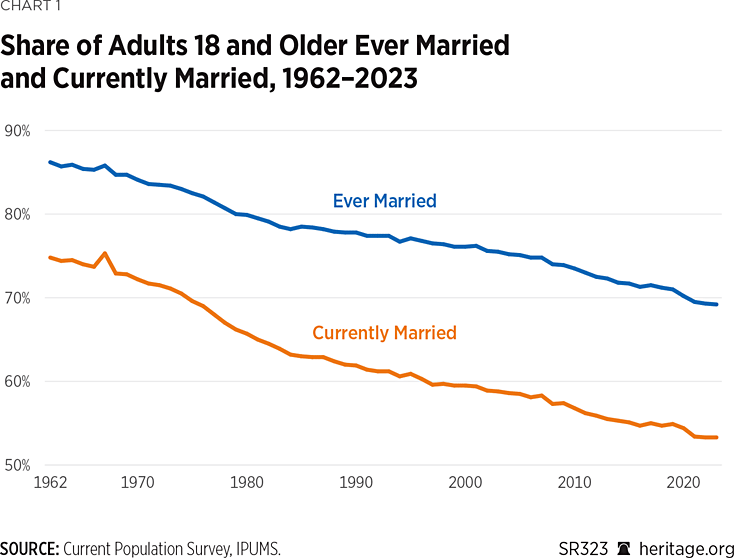
In the opening week of 2026, several scholars at the Heritage Foundation published a special report titled “Saving America by Saving the Family: A Foundation for the Next 250 Years.” This 168-page document covers myriad policies that negatively impact the American family and proposes solutions to those problems. Some, largely the solutions that propose repealing and reforming existing systems, can help families. But the calls to subsidize traditional family life will come with a host of unintended consequences.
The nation is indeed facing a demographic crisis, and some of Heritage’s proposals deserve praise, while others deserve criticism. One proposed reform is mentioned but given barely any attention: a return to sound money.
Helping the American family (broadly understood) is a laudable goal, but the patterns of later and fewer marriages, later and less-frequent reproduction, and a host of other family pathologies are themselves the result of a mountain of interventions. The American family must be saved from government, not by government.
America’s Demographic Squeeze: Fewer Births, More Dependents
The demographic decline facing the US is less sudden than often claimed, but no less consequential. As the Heritage report notes, fertility has remained below replacement rates for years, ensuring that natural population growth is weak. In the absence of sustained immigration, population growth is likely to become population contraction.
Simultaneously, the retirement of the Baby Boomer generation is steadily increasing the share of the population outside of the labor force, raising the dependency burden borne by working-age Americans and taxpayers.
These trends are already becoming visible. Slower growth or even shrinkage in the working-age population, absent significant immigration, constrains labor supply and limit economic growth potential. Meanwhile, Social Security and Medicare (the two largest expenditures in the federal budget) face rising expenditures precisely as the tax base supporting them grows more slowly. Additionally, the rise of the welfare state has greatly hampered family formation, especially among low-income families.
These changes underscore the need to remove institutional barriers to family formation and reform policies that underlie present challenges.
Remove Barriers Before Adding Benefits
Several laudable elements in the Heritage report shouldn’t be overlooked. First, it acknowledges that many policies favor traditional families. While there are indeed over 1,000 forms of federal privilege granted to married couples, these have been in place throughout the period when both marriage and fertility rates are falling. This raises the question: Why are these so-called “pro-family” or “pro-natal” policies failing to achieve their stated goals? Perhaps it’s because other measures on the books outweigh them, and actually short-circuit family formation.
The report’s authors call for a repeal of multiple policies that have been shown to deter and delay marriage, alter planned fertility, and even divorce patterns. Among them are “credits designed specifically to benefit poor single mothers,” and the structure and incentives from the Earned Income Tax Credit, which “strongly favors single parenthood over marriage.” The report also demands the elimination of “needless occupational licensure laws” that block young and lower-income earners from the labor force, undermining the early wealth-building that encourages marriage. Further, it seeks the easing of local zoning and construction regulations that make home affordability more difficult for younger, poorer households.
Heritage’s report frames the Israeli case as a model for what must be done to increase marriage and fertility rates. But the main reasons cited for (slightly) above-replacement fertility rates in Israel are religiosity, nationalism, and “Jewish communal life in exile,” all of which are summarized later as “culture, faith, and national purpose to family formation.” These specific pressures can’t, and shouldn’t, be replicated in modern, pluralistic societies. Further, the report rightfully admits, “While other nations have tried to reverse declining birthrates through financially generous family policies, none has succeeded in restoring fertility to replacement levels. This demonstrates that government spending alone does not ensure demographic success.”
Turning to Eastern Europe, the report looks to Hungary for policy solutions, interventions, and expenditures that have a more positive track record in increasing marriage and fertility. Indeed, Budapest began offering eligible brides interest-free loans, equating to over $30,000 for saying “I do” back in 2019. Moreover, the debt may be forgiven if the couple had three or more children. The report belies an important fact, however: the increase in the marriage rate is largely due to formerly cohabiting couples tying the knot. One would expect that once this initial wave of marriages has passed, the impact would be negated by other factors. In fact, just four years after the policy was introduced, the marriage rate began to fall back toward EU norms. The high cost of taxpayer-subsidized loans for cohabiting couples to make it official has had only temporary effects, and may prove, in the long run, to have produced marriages that are more apt to divorce, especially when the money runs out.
The Heritage Report correctly marks some of the causes of family disintegration: marriage penalties embedded in both welfare and fiscal interventions, especially for low-income households. The authors rightly call for their repeal. At the same time, the models they point to as ideal national cases for cultural and policy reform either can’t be replicated or are short on results. Worse still, the report’s greatest shortcoming is found in a drive-by mention of the single, foundational intervention that may actually be undermining all of traditional family life.
The Best “Pro-Family” Policy Is Price Stability
Buried within the report is a brief aside discussing the pressure a fiat monetary system and the resulting inflation has placed on families. The authors state:
High inflation can not only devastate the economy but also make it harder for families to form and grow. The US abandoned the gold standard in 1971, and the lack of convertibility of dollars to gold since then has facilitated reckless money printing and irresponsible federal spending, leading to bouts of high inflation in the 1970s, early 1980s, and the 2020s. Families rely on the dollar as a store of wealth, so the Federal Reserve must restore sound money and price stability. While many monetary rules have been proposed, the system with a proven record track record of success and stable prices is full convertibility to gold.
This passage, and its recommendation to return to full convertibility, are worth their weight in gold.
A few economists have pointed to the connection between increasing real prices in healthcare, education, and housing as key contributors to delays in marriage and lowered fertility rates.
Outside factors like regulatory pressure and geopolitical forces have doubtless contributed to rising real prices in these categories. But among these, the ongoing loss of purchasing power due to the loose money policies of the Federal Reserve and its member banks has received too little attention.
Even less attention is paid to the rise of what some have called the inflation culture. The Heritage report hints at this reality, but chalks it up to a loss of religiosity. But the decay of religious and civic life in the West has an undetected, underlying culprit. Because of the redistributive and impoverishing effects of easy money, a once-entrepreneurial and optimistic American culture has given way to a litany of social pathologies:
- Short-termism or fatalism (“in the long run, we’re all dead”)
- Reliance on credit and leverage to get ahead
- Long-term debts functioning as barriers to family formation
- A culture of “total work” that discounts family life and delays life milestones
- The two-income trap contributing to absent parents
- Hustle culture or “grindset” among young adults, to the exclusion of strong relationships
All are impacting family formation and family cohesion. All have their roots in the demoralization of persistent, slow-burning inflation, eating away the value of money. Younger generations hoping to live comfortably can reasonably ask: ‘Who has time for marriage and family?’ The answer: a lot fewer people than in generations past.
The damage done to the American family is likely reversible, but the Heritage Foundation’s report misses the root cause: inflation may be the most corrosive anti-family force of all. Policymakers who want to revive marriage rates and fertility should examine existing, counterproductive incentives, including new money creation and Congressional overspending. What they shouldn’t do is continue layering new interventions onto old ones, creating more bureaucracy and higher costs — but fewer weddings and babies.