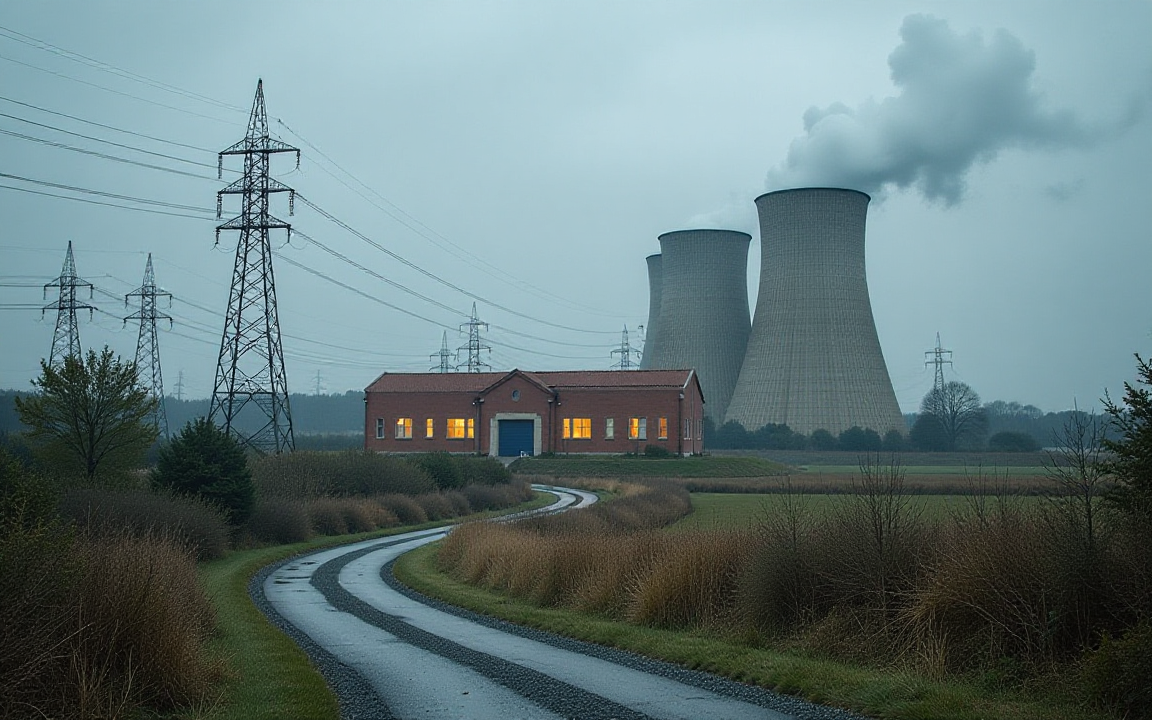

Drax Group announced on Thursday that it is considering converting a section of its Yorkshire power station in northern England into a data centre as early as 2027.
The project would repurpose land, cooling systems, and transformers that were previously used for coal generation, according to a Reuters report.
Europe’s landscape of energy infrastructure is on the cusp of a significant transformation, driven by the insatiable energy demands of the artificial intelligence boom.
Repurposing legacy infrastructure
Ageing coal and gas-fired power plants, once destined for decommissioning, are now attracting the attention of global tech behemoths like Microsoft and Amazon Web Services (AWS).
These companies are actively seeking to repurpose these legacy power generation sites into vast new data centres.
The primary appeal of these former power plants lies in their existing, robust infrastructure.
Crucially, they possess immediate, high-capacity grid connections, which are essential for powering the energy-intensive operations of modern data centres and their sophisticated cooling systems.
Furthermore, their location, often near major water sources, provides a ready-made and efficient supply for the considerable water-based cooling needs of these facilities.
This repurposing offers a dual benefit: it breathes new economic life into sites that might otherwise become industrial relics, and it helps technology giants rapidly scale their data centre footprint to keep pace with the explosion in AI-driven compute requirements.
This trend underscores a critical convergence point between the old industrial economy and the new digital economy, highlighting a pragmatic and sustainable way to leverage existing infrastructure to meet the unprecedented energy spike created by advanced AI applications and machine learning models.
Drax’s data centre strategy and capacity
Drax is planning a 100-megawatt data centre at its site, with a planning application currently being prepared.
The company aims to expand this capacity beyond 1 gigawatt after 2031 to meet the rapidly increasing British power demand, largely fueled by the rise of artificial intelligence.
“We would effectively provide the land and the power connection and the power working with a data centre developer,” Drax CEO Will Gardiner said in an interview to Reuters.
Due to the rapid expansion of data centres, companies are increasingly looking for sites that already possess power connections. This approach helps them bypass the long waiting times associated with connecting to the power grid.
Last month, RWE reported a book gain of 225 million euros ($263 million) following the sale of a former coal-fired power plant site in Britain to a data centre developer.
JPMorgan analysts said in a note on Drax’s plan.
While nothing has been agreed, we believe this is a more optimistic timeline than investors would otherwise expect.
Profit at top end
The power producer’s shares climbed over 2% following a forecast for 2025 core profit that is expected to be near the high end of market predictions.
This growth is driven by performance across its flexible generation, pellet production, and biomass divisions.
Drax aims to generate £3 billion in free cash flow between 2025 and 2031.
This cash flow is planned to be allocated for shareholder returns, with over £1 billion dedicated to this purpose, and up to £2 billion for funding growth investments.
The company is also shutting down its Williams Lake pellet plant in Canada and temporarily halting its Longview project.
This decision reflects an expectation not to invest in additional pellet production capacity in the near future.
The post Drax to convert Yorkshire power station into 1GW data centre to meet AI energy demand appeared first on Invezz